
₹3,890 Crore BECC Budget targets tax expansion, AI governance, and major infra push
Bengaluru
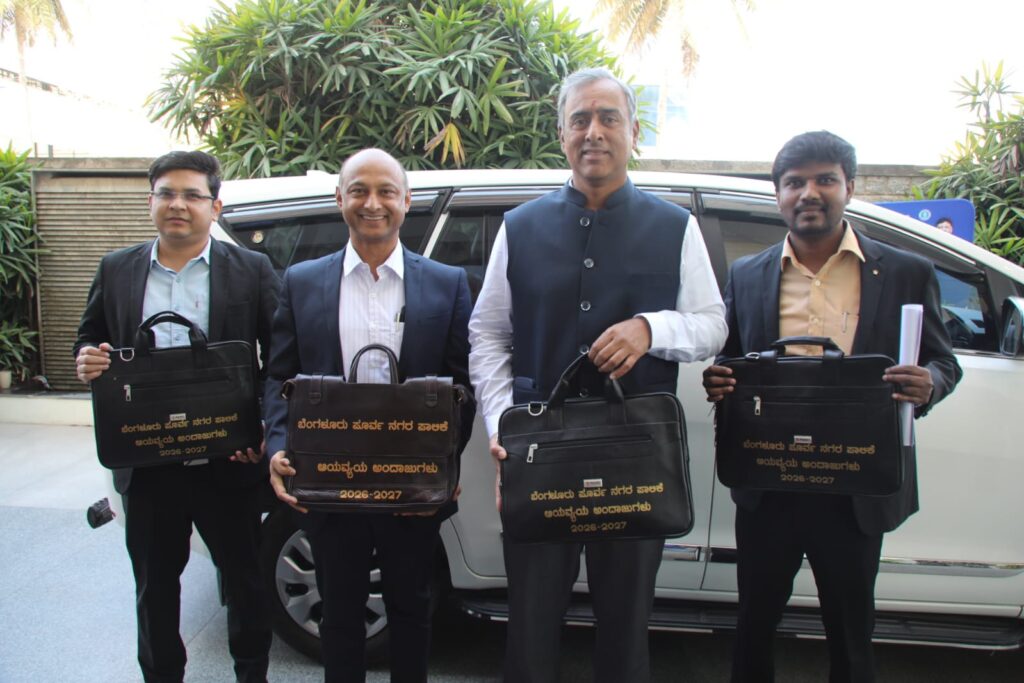
The newly formed Bengaluru East City Corporation (BECC) on Friday presented its first full-fledged budget for 2026–27, outlining an ambitious ₹3,890 crore financial plan anchored in aggressive revenue mobilisation, technology-led governance, and large-scale infrastructure expansion across the city’s eastern tech corridor.
Presented by Commissioner Ramesh D S, the budget projects total receipts of ₹3,890 crore against an almost identical expenditure of ₹3,889.98 crore, leaving a marginal surplus of ₹2 lakh—signalling a tightly balanced fiscal approach in its inaugural year.
At the heart of the budget is a strong reliance on property tax, expected to contribute ₹1,500 crore, accounting for 39% of total revenues. Civic authorities aim to significantly widen the tax base rather than increase rates, leveraging GIS mapping, AI-driven analytics, and integration with utility databases such as BESCOM and BWSSB. These measures alone are projected to yield an additional ₹150 crore annually, with another ₹100 crore expected through AI-led identification of defaulters. The ongoing conversion of ‘B Khata’ to ‘A Khata’ properties is estimated to bring in a further ₹225 crore annually.
The town planning division emerges as the single largest revenue engine, with projections of ₹982 crore from building approvals, premium FAR, and related fees, underscoring the rapid real estate expansion in areas like Whitefield, Mahadevapura, and Varthur.
On the expenditure front, a striking 62% of the budget—₹2,400.74 crore—has been earmarked for development works. Key infrastructure commitments include a ₹450 crore project to upgrade the Outer Ring Road from Silk Board to KR Puram, ₹150 crore for an elevated flyover from Varthur to Gunjur, and ₹50 crore each for junction redesigns and a proposed grade separator funded through municipal bonds. Additionally, ₹112.5 crore has been allocated for ward-level road and drainage development, while ₹298.1 crore will fund arterial and sub-arterial upgrades across major divisions.
The corporation has also committed ₹70 crore for land acquisition, having already secured 14 acres valued at ₹510 crore for road expansion projects—highlighting one of the most pressing bottlenecks in urban infrastructure delivery.
Sanitation and solid waste management receive ₹300 crore, while ₹227 crore is earmarked for infrastructure in SC/ST, backward class, and minority-dominated areas. Welfare spending stands at ₹221 crore, or 7% of the total budget, covering housing subsidies of ₹5 lakh per beneficiary, free electric two-wheelers for women workers, laptops for students, and financial assistance schemes targeting vulnerable groups.
The budget places heavy emphasis on digital governance, introducing blockchain-backed e-khata systems covering 4.5 lakh properties, an AI-based attendance system for staff, and a public dashboard to track ward-level spending. Administrative modernization includes ₹25 crore for constructing a new corporation headquarters and ₹6 crore for software systems.
Flood mitigation and climate resilience also feature prominently, with ₹629 crore worth of stormwater drain projects under World Bank assistance already underway. Of 58 identified flood-prone areas, 38 have been addressed, with the remaining targeted for completion. Lake rejuvenation continues with ₹28 crore for maintenance and ₹25 crore for development of four lakes, part of a broader push to strengthen groundwater systems.
Public health infrastructure will see ₹35 crore invested in 15 new primary health centres and 10 Namma Clinics, while ₹4.8 crore has been allocated for disease control programmes. In parallel, ₹38 crore will fund the transition to LED street lighting, and ₹160 crore—backed by private sector participation—will go towards a 9 km pedestrian corridor along the metro viaduct on Outer Ring Road.
Revenue from advertisements is expected to contribute ₹68 crore, aided by new rules allowing conversion of legacy hoardings and monetisation of skywalks and bus shelters.
Emerging as a defining theme, the budget attempts to balance Bengaluru’s rapid urbanisation with sustainability goals, introducing the “Sponge City” concept, Miyawaki forests, and plans to plant 25,000 trees in collaboration with agencies like BMRCL.
As Bengaluru’s eastern corridor continues to anchor India’s technology economy, the success of this ₹3,890 crore blueprint may well determine whether the city can reconcile its growth ambitions with long-standing challenges of congestion, flooding, and uneven urban development.