
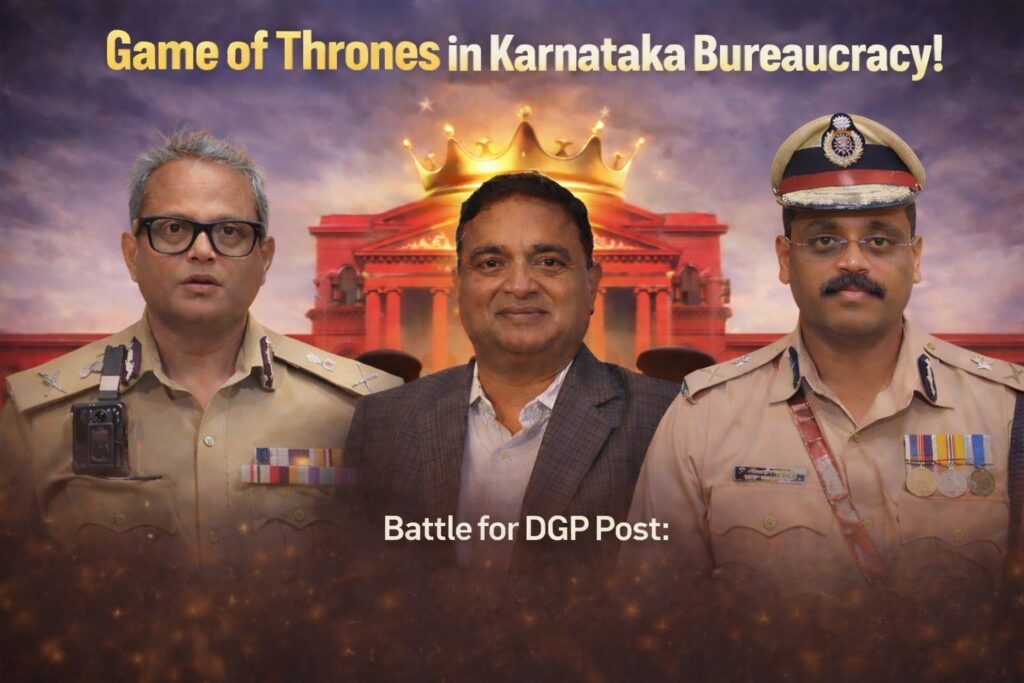
Game of Thrones at the Top: Karnataka police caught in a high-stakes DGP succession battle
Bengaluru
Karnataka’s bureaucracy is currently witnessing a classic “Game of Thrones” scenario, with senior Indian Police Service (IPS) officers locked in an intense struggle for a single vacant Director General of Police (DGP) post. The standoff has exposed deep fault lines in the State’s personnel management, political decision-making, and long-standing conventions governing seniority within the police force.
At present, only one DGP-rank vacancy exists in Karnataka, but three senior IPS officers are in contention for it: former Bengaluru Police Commissioner B Dayananda (1994 batch), Umesh Kumar (1995 batch), and Arun Chakravarthy (1995 batch). The situation, many within the system argue, could have been avoided had the State government taken a timely decision to promote/punish Alok Kumar and B Dayananda earlier. The government’s reluctance to do so has now snowballed into an unprecedented administrative crisis.
The Siddaramaiah-led Congress government appears unsure about how to resolve the impasse, which insiders say is largely of its own making. The responsibility of damage control now squarely rests with the Home Department, which must find a legally tenable and administratively fair solution before the matter further destabilises the police hierarchy.
A key factor behind the current deadlock is the government’s longstanding unease with promoting 1994-batch IPS officer Alok Kumar Thakur to the top post. This hesitation traces back to Siddaramaiah’s first term as Chief Minister, when Alok Kumar was suspended in 2015 over alleged involvement in the banned single-number lottery, commonly known as “Matka.” The case involved Pari Rajan, a notorious lottery kingpin operating illegally across Karnataka. During a CID operation led by then Economic Offences Wing chief Hemant Nimbalkar, Alok Kumar was allegedly accused of instructing officers not to arrest Rajan. The controversy led to his suspension, and the case was later handed over to the CBI.
Although the CBI eventually gave Alok Kumar a clean chit, the episode left lasting political scars. Siddaramaiah and his then adviser Kempaiah were reportedly unwilling to assign him influential executive roles. As a result, Alok Kumar remained sidelined until the Congress–JD(S) coalition government came to power in 2018. Under Chief Minister H D Kumaraswamy, he was appointed Additional Commissioner of Police (Crime), Bengaluru.
In a move that stunned the bureaucracy, Alok Kumar was appointed Bengaluru Police Commissioner on the very day he was promoted to the rank of Additional Director General of Police (ADGP). This marked the first instance of an officer assuming the Commissioner’s post immediately upon promotion, bypassing several seniors and batchmates. The decision triggered resentment within the service and further aggravated Siddaramaiah, who was already unhappy with Kumaraswamy’s ascension to the Chief Minister’s post and his perceived patronage of Alok Kumar.
The controversy escalated when Bhaskar Rao, a senior IPS officer and former Bengaluru Commissioner (now associated with the BJP), expressed his displeasure over Alok Kumar’s appointment, citing violation of seniority norms. Karnataka has traditionally followed a strict culture of respecting seniority in IPS postings, though this convention had earlier been breached during the BJP’s tenure when Raghavendra H Auradkar was appointed Commissioner despite six seniors being in the fray.
Bhaskar Rao’s efforts to put pressure on the government succeeded, and Alok Kumar was transferred within just 49 days of assuming office. In response, Alok Kumar allegedly leaked a tapped phone conversation involving Bhaskar Rao and a person claiming proximity to the Congress high command. The audio was handed over to then News 18 Kannada journalist Kushala Satyanarayana before it was aired. This journalist was questioned multiple times by the Central Bureau of Investigation (CBI).
He also approached the Central Administrative Tribunal (CAT) against his sudden transfer. However, matters took a dramatic turn when Bhaskar Rao lodged a formal complaint accusing Alok Kumar of illegal phone tapping and leaking conversations. The case was eventually referred to the CBI.
After prolonged legal battles, both officers reportedly reached an understanding driven by mutual self-interest. Alok Kumar withdrew his CAT plea, while Bhaskar Rao refrained from pressing for strict action in the phone-tapping case. The CBI subsequently closed the case against Alok Kumar, but not without consequences. In its closure report submitted to the Karnataka Home Department, the agency reportedly flagged several instances of illegal phone tapping during Alok Kumar’s tenure as Additional Commissioner.
According to senior officials, the report caused considerable unease within political and administrative circles. “The CBI detailed extensive illegal surveillance. The names mentioned are shocking—IAS and IPS officers, politicians, actors, and even influential religious heads were allegedly monitored,” a senior officer said. This report became a critical factor in the State government’s decision to withhold Alok Kumar’s promotion, citing a pending departmental inquiry in its submission to the CAT. Though Alok Kumar eventually secured promotion through legal intervention, the shadow of controversy persisted.
Meanwhile, B Dayananda, the 1994-batch officer and former Bengaluru Police Commissioner, was suspended following the tragic stampede during the RCB victory parade. Unlike Alok Kumar, Dayananda has not approached the CAT so far. Sources suggest he expects eventual promotion and is reluctant to confront the government directly.
In an attempt to bypass both Alok Kumar and B Dayananda, the government took the controversial step of promoting junior officers—Umesh Kumar and Arun Chakravarthy, both from the 1995 batch—to the DGP rank. This move backfired when Alok Kumar challenged the promotions, leading the CAT to stay the government order. As a result, Umesh Kumar and Arun Chakravarthy are currently drawing DGP-level pay but face uncertainty over their future status.
For Arun Chakravarthy, the situation is particularly critical. With retirement approaching sooner than that of Prashant Kumar Thakur, this is effectively his last chance for elevation. Failure to secure promotion now could mean reverting to the ADGP rank upon retirement. The government now faces a complex dilemma: whether to demote both Umesh Kumar and Arun Chakravarthy and promote Dayananda, demote only Arun while retaining Umesh, or find another workaround—all options fraught with legal and administrative challenges due to the CAT’s stay.
Senior officers argue that the crisis has no easy solution. “It is unfair to demote officers for no fault of theirs, but it is equally unjust to permanently deny promotion to a senior IPS officer,” one officer remarked. The Centre, meanwhile, is unlikely to approve additional DGP posts. “Karnataka has a sanctioned strength of around 200 IPS officers. Expecting seven or eight DGPs for this cadre is unrealistic and even laughable,” another senior officer observed.
According to sources, to mitigate the crisis, the State government is planning to seek an additional DGP post over and above the existing sanctioned strength.
Speaking to blrpost.com, Tushar Giri Nath, Additional Chief Secretary to the Home Department, said, “we had sought an additional DGP post earlier, and it is under mid-term review by the Ministry of Home Affairs and the Department of Personnel and Training at the Centre. We are hopeful of solving the crisis.”
Currently, Karnataka has a total of six DGP-rank posts, of which four are cadre posts and two are ex-cadre posts. A cadre post means it is a State-based post, while an ex-cadre post is approved by the Ministry of Home Affairs.
Karnataka has the following cadre DGP posts: DG&IGP (Head of Police Force), DGP CID, DGP Fire and Emergency Services, DGP Internal Security Division, and DGP Prisons. Posts such as DGP, Directorate of Civil Rights Enforcement, DGP Training/Recruitment/Cybercrime, or similar assignments are considered ex-cadre posts.
At present, Karnataka has five DGP-rank officers:
• Dr M A Saleem – Director General and Inspector General of Police
• Prashant Kumar Thakur – DGP, Fire and Emergency Services
• Dr K Ramachandra Rao – DGP, Civil Rights Enforcement
• Dr Pronab Mohanty – DGP, Cyber Command and Internal Security
• Alok Kumar – DGP, Prisons
In the queue for the next elevation are B Dayananda (1994 batch), Umesh Kumar (1995 batch, senior ji in UPSC ranking), and Arun Chakravarthy (1995 batch, junior to Umesh Kumar). Until the government finds a credible and lawful resolution, the battle for the DGP’s chair is set to continue, casting a long shadow over Karnataka’s police administration.
Community leaders bat for their officers
According to sources, leaders from the communities of IPS officers are lobbying to secure DGP posts for them. B Dayananda belongs to the Scheduled Tribe community, Arun Chakravarthy to the Scheduled Caste community, and Umesh Kumar is a Brahmin. Religious leaders, political heavyweights, and other influential figures are reportedly lobbying on behalf of these officers. However, the government remains clueless about how to douse the fire, and a permanent solution to this “Game of Thrones” appears elusive.