
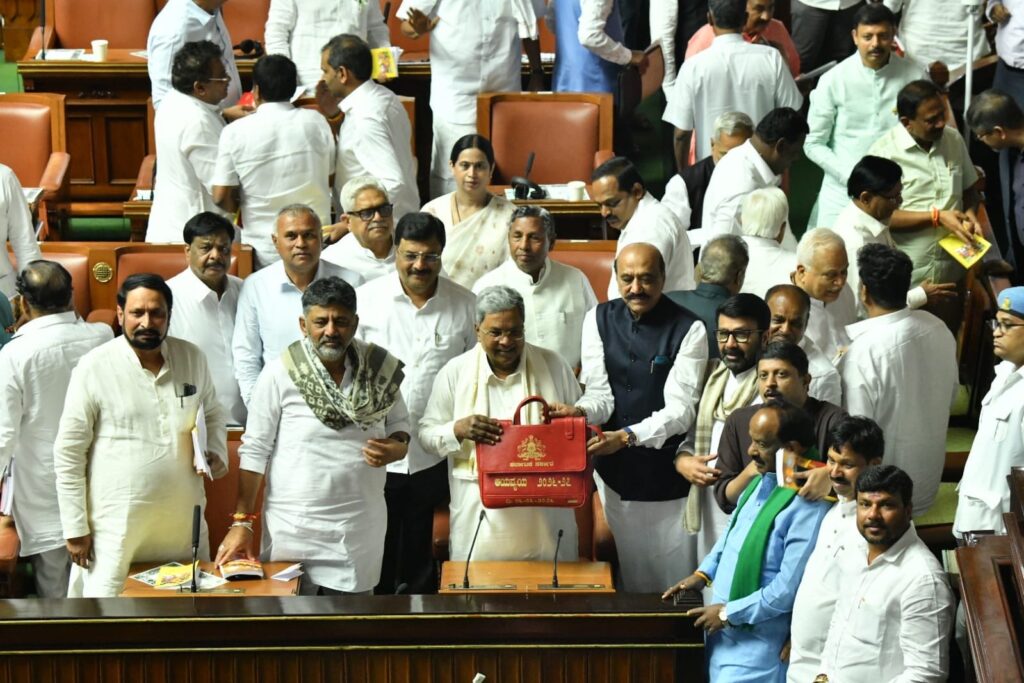
Karnataka Budget: 41 km of Metro lines to open in Bengaluru this year, no new lines announced
Bengaluru:
Expansion of the city’s metro network found no mention in the State Budget presented by Chief Minister Siddaramaiah on Friday but he said the Karnataka government planning to open 41 km of new metro lines during the 2026–27 financial year as part of efforts to ease congestion and improve public transport.
The 41-km, CM referred to, includes Blue line stretching 19-km km along Outer Ring Road from and the 21.5-km Pink line from Kalena Agrahara on Bannerghatta Road to Nagawara.
The additional metro stretch is expected to significantly increase the reach of Namma Metro, which currently operates a network of 96 km and carries around 10 lakh commuters daily. With the new lines becoming operational, the system is projected to serve about 15 lakh passengers every day, according to the state budget.
So far, a total of ₹67,460 crore has been spent on the metro project, with the state government contributing ₹59,376 crore, accounting for nearly 88% of the funding, while the Centre has contributed ₹8,084 crore, CM said.
Alongside metro expansion, a 9-km pedestrian walkway along the metro viaduct on the Outer Ring Road will also be developed at an estimated cost of ₹160 crore, aimed at improving last-mile connectivity in one of the city’s busiest technology corridors.
₹7,000 crore annual grant for Bengaluru
The budget continues the ₹7,000 crore grant earmarked for Bengaluru’s development, which had been increased from ₹3,000 crore in the previous year following the creation of the Greater Bengaluru Authority (GBA) and the restructuring of the city’s civic administration.
The government said the GBA and the five city corporations will also mobilise additional resources through municipal bonds, signalling a shift towards alternative financing models for urban infrastructure.
Roads and civic infrastructure
Several road infrastructure projects are also planned for the city. The government intends to undertake white-topping of over 450 km of roads over the next three years to improve durability and reduce maintenance costs.
The city corporations will also implement works such as:
Beautification of 175 junctions Upgradation of 500 km of footpaths Construction of 100 skywalks
These projects are expected to be funded largely through the internal resources of the corporations.
Stormwater infrastructure is also receiving attention. Upgradation of major stormwater drains is being implemented under a World Bank-assisted Water Security and Disaster Resilience programme at an estimated cost of ₹2,000 crore, aimed at addressing flooding in vulnerable parts of the city.
Major transport corridors planned
The budget outlines several large mobility projects aimed at reducing Bengaluru’s traffic congestion.
Among the biggest proposals are the North–South and East–West tunnel corridors, covering about 40 km, which have been approved at an estimated cost of ₹40,000 crore under a build-operate-transfer model. In the first phase, tenders have already been invited for a 17-km North–South corridor costing ₹17,780 crore.
In addition, a tunnel road and elevated road between Hebbal Junction and Mekhri Circle will be taken up by the Bangalore Development Authority at a cost of ₹2,250 crore.
Another proposed project is the Nelamangala–Tavarekere–Bidadi intermediate ring road, which aims to divert traffic away from the city core.
Water supply and planning initiatives
The government has also proposed the Cauvery Water Supply Phase-VI project, estimated at ₹6,939 crore, which aims to supply an additional six TMC of water to the city. Currently, about 2,225 MLD of water is supplied to Bengaluru through the existing Cauvery phases.
On the planning front, the government plans to implement a Revised Master Plan 2041 for Bengaluru by 2027, along with a new Comprehensive Mobility Plan to guide the city’s long-term growth and transport network.