
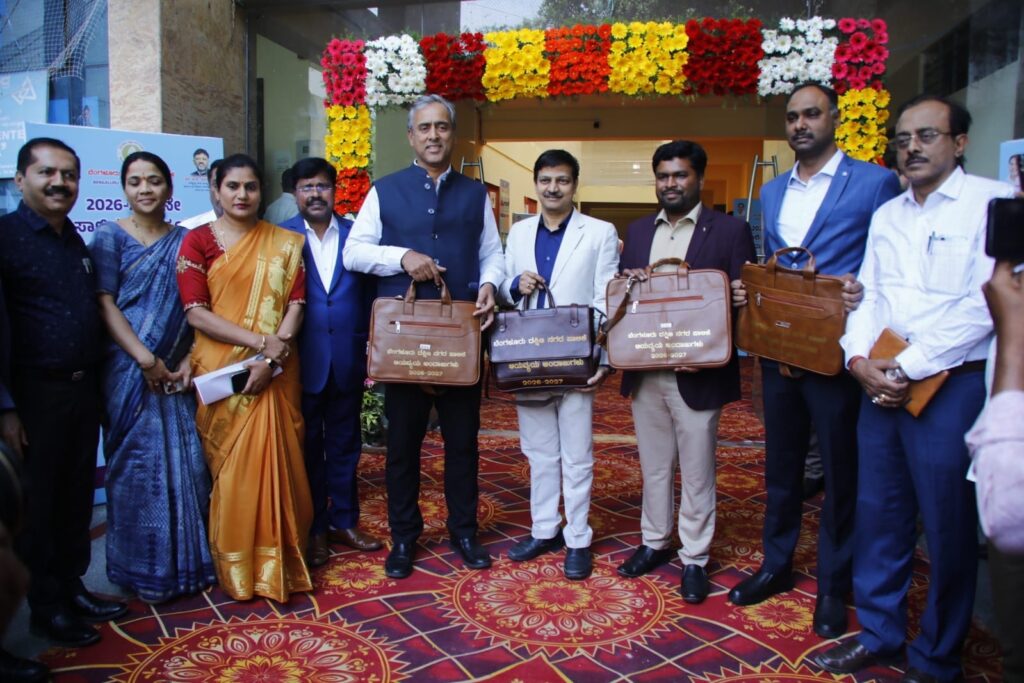
West Leads, Central Trails in ₹20,217 Crore Bengaluru Civic Budgets for New Fiscal Year
Bengaluru:
In their first-ever budgets, the five city corporations under the Greater Bengaluru framework have collectively proposed a total outlay of ₹20,217 crore for 2026–27, signalling an ambitious start to decentralised urban governance.
Among them, the West City Corporation has proposed the highest outlay at ₹4,733 crore, followed by the North City Corporation with ₹4,341 crore.
The East City Corporation has pegged its budget at ₹3,890 crore, while the South City Corporation has proposed ₹3,826 crore.
The Central City Corporation, covering the core areas, has presented the smallest outlay at ₹3,427 crore.
A new governance phase
These budgets mark the first financial blueprints after the restructuring of Bengaluru’s civic administration into multiple corporations. The move is aimed at improving administrative efficiency, enabling localised planning, and addressing long-standing infrastructure gaps across rapidly expanding urban zones.
With each corporation now responsible for its own finances and service delivery, the budgets reflect both local priorities and varying revenue capacities across regions.
A common thread across all five corporations is a heavy reliance on property tax as the primary revenue source. Given Bengaluru’s expanding real estate base, property tax continues to form the financial backbone of civic operations. However, officials acknowledge that collection efficiency and compliance remain key challenges, especially in newly added areas and peripheral layouts.
Despite sizeable outlays, the budgets also underscore a significant dependence on state government grants to bridge funding gaps. These grants form a crucial component of the revenue mix, particularly for corporations with lower internal revenue generation.
In addition to property tax and grants, corporations are looking at alternative revenue sources such as advertisement fees, betterment charges, and premiums from Floor Area Ratio (FAR) relaxations.
With decentralisation now in motion, the coming fiscal year will be crucial in determining whether these corporations can translate financial outlays into tangible improvements on the ground.