
Where Karnataka’s money goes: Welfare, salaries take the lion’s share
Bengaluru:
Karnataka’s ₹4.48 lakh crore budget for 2026–27 reveals a fiscal structure where a large share of expenditure is tied to committed spending such as salaries, pensions, subsidies and welfare guarantees, leaving a relatively smaller portion for infrastructure and capital investment.
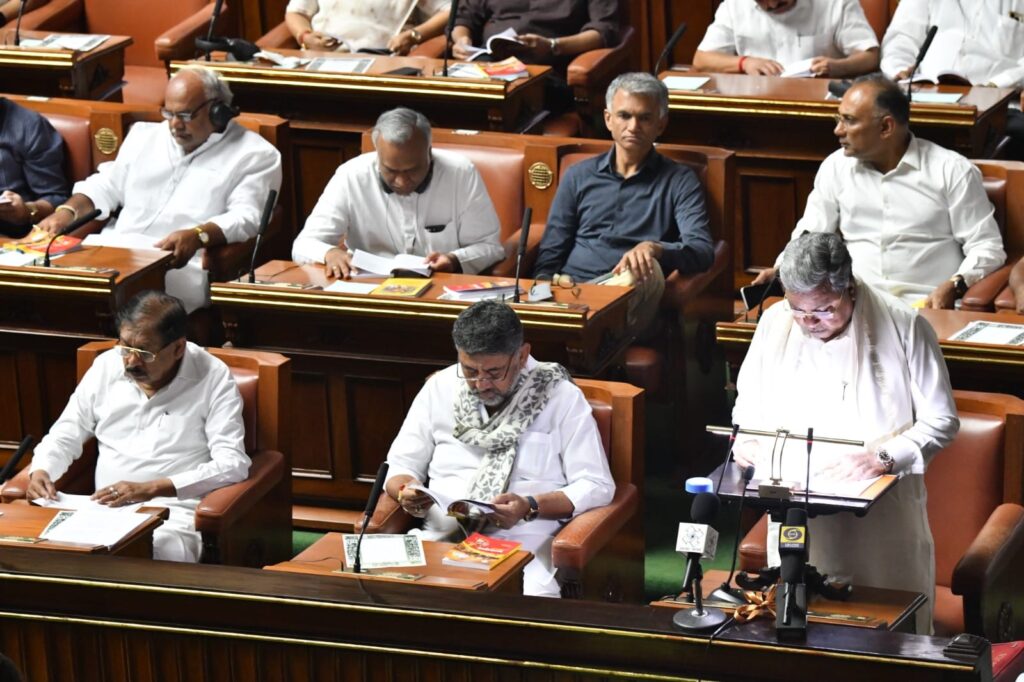
Chief Minister Siddaramaiah presented his 17th state budget on Friday.
The total expenditure for the year is estimated at ₹4,48,004 crore, comprising ₹3,38,007 crore in revenue expenditure, ₹74,682 crore in capital expenditure and ₹35,316 crore towards loan repayment.
Revenue expenditure accounts for nearly three-fourths of the budget, indicating that most spending goes towards ongoing commitments rather than the creation of new assets.
In simple terms:
Out of every ₹100 Karnataka spends
₹25 goes to salaries and pensions
₹11 goes to interest payments
₹22 goes to subsidies and guarantees
₹17 goes to infrastructure
₹8 goes to loan repayment
₹17 goes to other development programmes
A defining feature of the current fiscal framework is the scale of welfare commitments. Since the introduction of the state government’s five guarantee schemes in 2023, around ₹1.21 lakh crore has already been spent on these programmes.
Among them, the Gruhalakshmi scheme alone accounts for ₹28,608 crore in the current budget, providing monthly financial assistance to women heads of households.
The Gruha Jyothi scheme, which offers free electricity to households, has been allocated ₹10,578 crore, while the Shakti programme providing free bus travel for women will cost ₹5,300 crore in 2026–27.
Another ₹6,200 crore has been earmarked for the Annabhagya programme, which will now provide a monthly food kit to beneficiaries.
Taken together, the guarantee schemes form one of the largest components of the state’s expenditure and remain the central pillar of the government’s welfare strategy.
Salaries, pensions and subsidies
Like most state budgets, a large share of spending is also tied to government salaries, pensions and administrative costs. The government has initiated recruitment to fill over 56,000 vacant posts across departments, which could further increase the salary bill in the coming years.
Subsidies, particularly in the agriculture and power sectors, continue to represent a major fiscal commitment. Electricity subsidy for irrigation pump sets alone has been allocated ₹19,290 crore this year.
Combined with other agricultural support programmes and welfare schemes, subsidies remain a major component of revenue expenditure.
Rising debt obligations
The state’s debt burden also continues to shape spending priorities. Total liabilities are projected to reach ₹8.24 lakh crore by the end of the financial year, amounting to about 24.9% of the state’s Gross State Domestic Product (GSDP).
Interest payments therefore consume a significant share of government resources, while ₹35,316 crore has been earmarked for repayment of past loans in the current budget.
Despite these pressures, the government has kept the fiscal deficit at ₹97,449 crore, or 2.95% of GSDP, within the limits prescribed under the Fiscal Responsibility framework.
Limited space for capital investment
While the government has emphasised infrastructure development in sectors such as irrigation, transport, health and urban development, capital expenditure stands at ₹74,682 crore — roughly one-sixth of the total budget.
This reflects the constraints imposed by committed expenditure, as large portions of the budget are locked into welfare schemes, subsidies, salaries and debt servicing.
Balancing welfare and growth
The budget attempts to balance social protection with economic development. Karnataka continues to invest in sectors such as education, healthcare, irrigation and urban infrastructure while maintaining its welfare commitments.
However, the fiscal structure shows that a majority of the state’s spending is already tied to fixed obligations such as salaries, pensions, subsidies and interest payments.
As Karnataka’s economy grows, the challenge for policymakers will be sustaining welfare commitments while creating enough fiscal space for long-term infrastructure and development spending.