
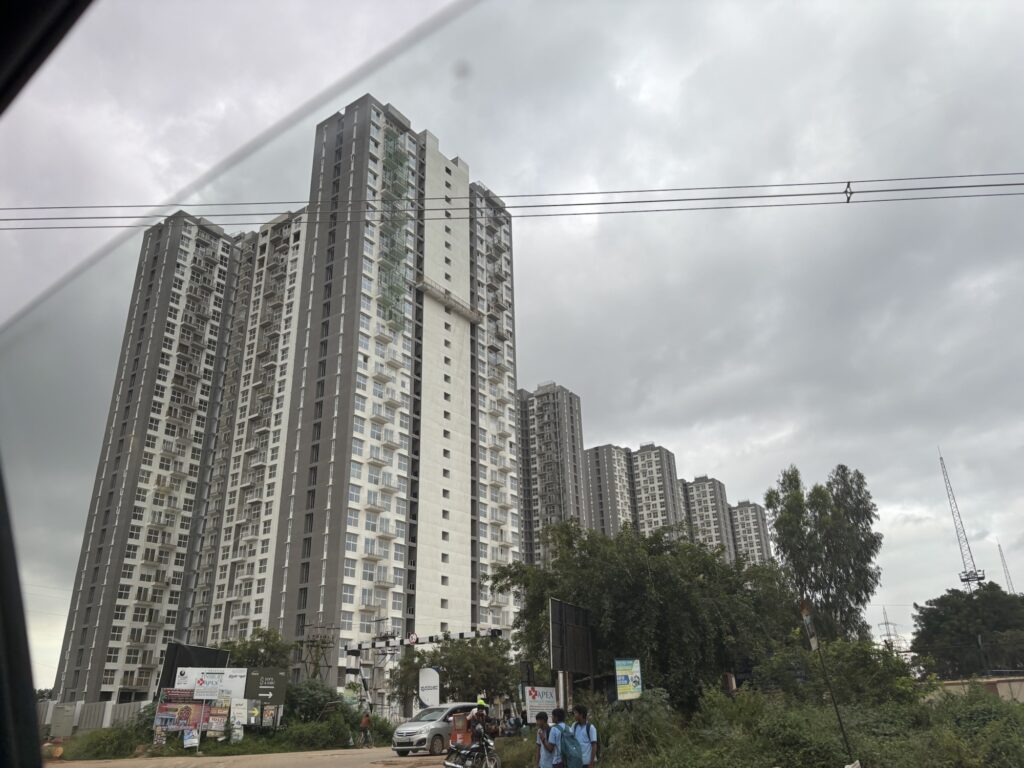
Must read: New Bill seeks to end disputes over apartment ownership and maintenance in Karnataka
Bengaluru:
In a significant move aimed at ending long-standing disputes over apartment ownership, common amenities and maintenance charges, the Karnataka government has drafted The Karnataka Apartment (Ownership and Management) Bill, 2025, proposing to repeal existing fragmented laws and replace them with a single, comprehensive legislation aligned with the Real Estate (Regulation and Development) Act (RERA) .
The proposed Bill seeks to address multiple grey areas that have plagued apartment complexes across the State — from the transfer of land beneath common amenities to unclear authority over by-laws, redevelopment, safety accountability and enforcement of maintenance payments.
Why a new law?
According to the government, the existing legal framework has failed to clearly define ownership of common areas, specify responsibility for safety and security, or provide remedies against flat owners who default on maintenance payments. The overlap between the Urban Development Department and the Cooperation Department has further added to confusion in enforcement.
To resolve these issues, the State proposes to repeal the Karnataka Apartment Ownership Act, 1972, and related provisions, and enact a single law bringing all processes — from association registration to dispute resolution — under the Urban Development Department .
Who will the Bill apply to?
The Bill will apply to all residential projects containing more than eight apartments. Existing associations registered under the present law will automatically be deemed associations of apartment owners under the new Act.
Crucially, in cases where apartment ownership has already been transferred but deeds for common areas have not been executed, developers will be required to complete the transfer within 12 months of the Bill coming into force.
Clearer ownership definitions
One of the key features of the Bill is the introduction of statutory definitions to remove ambiguity around ownership. The law clearly defines super built-up area to include carpet area, balconies, external walls and a proportionate share of common areas.
It also distinguishes between undivided interest (rights relating to use, governance and maintenance of common areas) and undivided share (notional ownership of common areas). Both are to be calculated in proportion to the super built-up area of each apartment.
Importantly, the land on which common areas and facilities are built will be transferred as an undivided share to all apartment owners, addressing long-standing disputes over ownership of amenities and property tax liabilities.
Maintenance charges linked to apartment size
The proposed law also clarifies how maintenance charges are to be levied — an issue that has triggered frequent litigation. While a recent civil court ruling held that all flat owners should pay the same maintenance fee irrespective of apartment size, the Bill proposes that maintenance charges be levied in proportion to the super built-up area, a norm widely followed in large apartment complexes.
In addition, associations will be allowed to levy separate user charges for community and commercial facilities such as clubhouses, swimming pools and shops, over and above regular maintenance charges.
Stronger role for apartment associations
Under the Bill, the formation of societies for maintenance will be replaced by mandatory associations of apartment owners. These associations will be responsible for maintenance of common areas, building safety, accounts and audits, and levy of charges.
Associations will not be permitted to undertake structural modifications or redevelopment without the consent of 75% of apartment owners. The law also enables associations to raise a common capital fund for renovation and redevelopment.
Apartment owners, in turn, will be legally bound to follow by-laws, pay maintenance and capital contributions, and avoid actions that compromise the safety or structural integrity of the building.
Promoter obligations aligned with RERA
The Bill aligns the duties of promoters with RERA provisions. Developers will be required to facilitate the formation of associations once more than 50% of apartments are booked, hand over all original documents and plans, transfer unpaid amounts to the association, and maintain common areas until the association takes charge.
Dispute resolution and enforcement
To ensure effective implementation, the Bill proposes a competent authority drawn from local bodies or planning authorities, vested with powers to approve by-laws, investigate complaints, resolve disputes and even temporarily discharge the functions of an association if two-thirds of apartment owners seek intervention.
A two-tier appellate mechanism is also proposed, with strict timelines of 90 days and 30 days for disposal of appeals. Additionally, a State-level Consultation and Advisory Committee with representation from apartment owners’ associations has been proposed to guide policy implementation.
What lies ahead
If enacted, the Bill is expected to bring clarity, uniformity and stronger accountability to apartment living in Karnataka — particularly in cities like Bengaluru where vertical housing has become the dominant urban form. However, resident welfare associations and developers are likely to closely scrutinise provisions related to maintenance charges, redevelopment consent thresholds and enforcement powers as the Bill moves forward.