
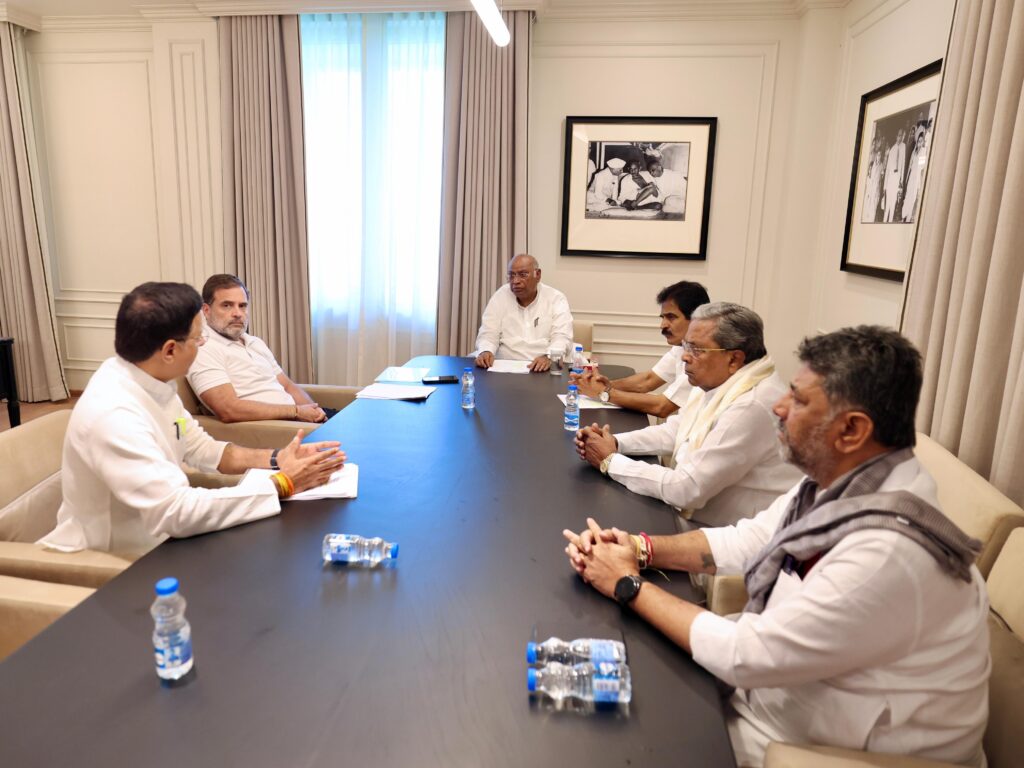
AICC President Mallikarjun Kharge, Leader of Opposition in Lok Sabha Rahul Gandhi, AICC General Secretaries K.C. Venugopal and Randeep Singh Surjewala, Karnataka Chief Minister Siddaramaiah, and Deputy Chief Minister D.K. Shivakumar participated in a meeting at the new AICC office 'Indira Bhavan' in New Delhi recently (File Photo)
Rahul Gandhi was ‘not in loop’ on Siddaramaiah–Shivakumar power-sharing pact: Sources
Bengaluru/Delhi
The much-discussed leadership change in Congress-ruled Karnataka is unlikely to take place anytime soon, as the party high command was reportedly not directly involved in the alleged “2.5-year power-sharing pact” between Chief Minister Siddaramaiah and Deputy Chief Minister D. K. Shivakumar.
Highly placed sources close to the Congress leadership revealed to blrpost.com that Rahul Gandhi was neither present nor formally informed when the alleged agreement occurred in 2023, soon after the Congress returned to power in Karnataka. According to the source, the only senior leaders who were aware of the development at the time were K C Venugopal, AICC General Secretary (Organisation), and Randeep Singh Surjewala, the party’s General Secretary in charge of Karnataka.
“Rahul Gandhi was neither a witness to the pact nor was he formally briefed about it when it unfolded. The understanding was primarily handled by Venugopal and Surjewala,” the source said.
The source further claimed that Gandhi is keen to avoid any confrontation over the alleged arrangement, particularly because he was not a participant in the discussions that led to it. Instead, he has reportedly asked Venugopal and Surjewala to address and resolve the situation arised from the agreement.
Gandhi is understood to have conveyed his displeasure over the manner in which the matter was handled. According to party insiders, the so-called informal arrangement was reached without keeping the Gandhi family fully in the loop, which has caused some resentment within the party’s top leadership. Sources say Gandhi believes that decisions of such political significance should have been discussed with the party’s central leadership before any understanding was reached.
Although rumours about a rotational chief ministership had circulated in political and media circles during the early months of the Congress government in Karnataka, the issue resurfaced prominently only after Shivakumar publicly referred to it around November 2025. His remarks reignited speculation that the state could witness a leadership change midway through the government’s tenure.
Following those remarks, both Siddaramaiah and Shivakumar appeared to engage in a subtle political exchange through cryptic posts and statements, which observers described as a form of “shadow-boxing” on social media. The episode intensified internal speculation within the party and triggered renewed discussions about the alleged power-sharing formula.
However, sources suggest that Gandhi has made it clear that he does not intend to take an immediate call on any leadership change. Instead, he has directed the two state leaders to maintain coordination and work together to ensure stability within the government.
It was reportedly on the instructions of the central leadership that Siddaramaiah and Shivakumar recently held meetings and visited each other’s residences in Bengaluru, in what was seen as an effort to signal unity and ease internal tensions within the Karnataka Congress.
Meanwhile, Shivakumar is said to be making sustained efforts to strengthen his position within the party’s national leadership. According to sources, he has been engaging with senior leaders including Priyanka Gandhi Vadra and Sonia Gandhi in an attempt to consolidate support and rebuild confidence with Rahul Gandhi.
Despite these efforts, insiders say that Gandhi is unlikely to make any decisive move on the Karnataka leadership issue in the immediate future. Party strategists believe that removing Siddaramaiah at this stage could create political instability and potentially affect the Congress’ prospects in upcoming elections in key states such as Kerala and Tamil Nadu.
According to the source, the Congress leadership currently views political stability in Karnataka as crucial to the party’s broader national strategy. As a result, any discussion on a possible leadership transition is likely to be deferred at least until the completion of major electoral contests in southern states.
For now, the message from the party’s central leadership appears to be clear: maintain unity, avoid public confrontation, and focus on governance rather than internal power struggles.