
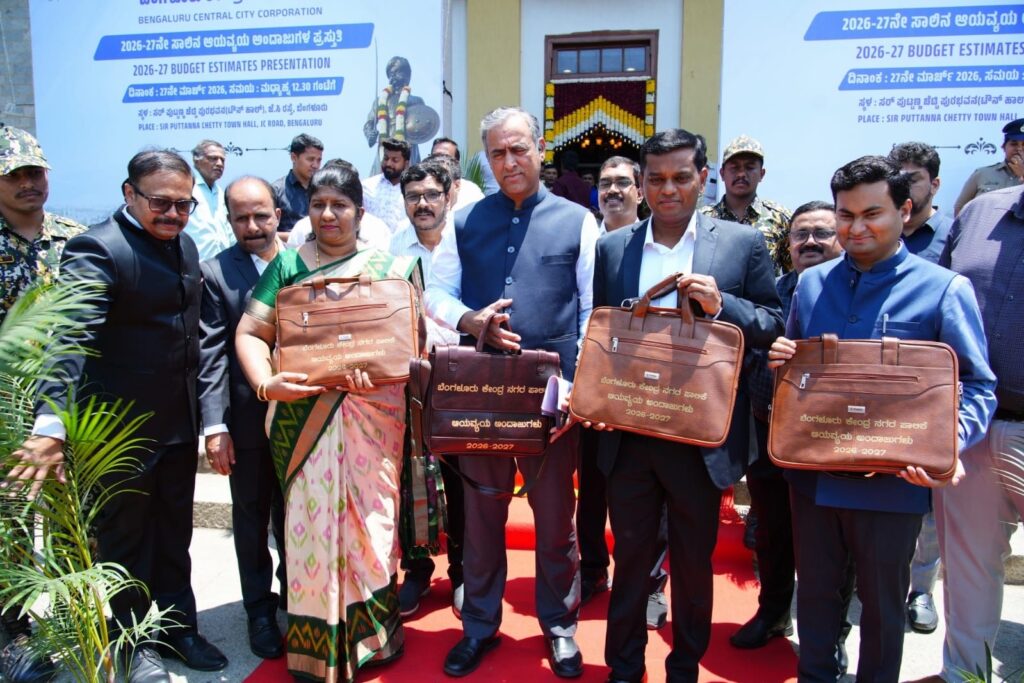
Bengaluru Central Corporation unveils ₹3,427 Crore Budget, bets on tech, roads and welfare
Bengaluru
In a significant step towards redefining governance in the city’s core, the newly formed Bengaluru Central City Corporation (BCCC) on Friday presented its inaugural budget for 2026–27, with a total outlay of ₹3,427 crore and a modest surplus of ₹1.38 crore.
Positioned as a bridge between Bengaluru’s historic legacy and a technology-led future, the budget lays emphasis on digital governance, infrastructure upgrades, social welfare, and sustainable urban planning.
Corporation Commissioner Rajendra Cholan P. described it as more than a financial statement, calling it a “human-centric blueprint” aimed at improving everyday life. A major highlight is the push for digitisation through the e-Khata system, which has already seen over 84,000 properties onboarded, reducing the need for physical visits to civic offices.
The corporation has also committed to making all wards pothole-free, alongside establishing a dedicated Urban Design Cell to elevate road and public space planning to global standards.
Revenue push and new tax measures
BCCC has set an ambitious tax collection target of ₹1,150 crore for 2026–27, up from ₹900 crore collected in the previous year. To augment revenues, new measures include a 5% levy on guidance value for A-Khata conversions and a 2% charge on stamp duty for new Khatas.
The budget also leans on asset monetisation, expecting ₹58 crore in rental income from 438 civic properties, while markets are projected to contribute ₹25 crore. Notably, ₹70 crore has been earmarked for the redevelopment of the historic Russell Market.
Infrastructure gets lion’s share
Public works dominate the budget, with a massive ₹1,760 crore allocation. Key projects include:
– Asphalting of 145 km of arterial and sub-arterial roads
– Development of 115 km of ward roads ₹141.75 crore earmarked for ward-level development
– Construction of community buildings and upgrading stormwater drains
– The corporation also plans to transform spaces under flyovers into micro-parks and cultural hubs, aiming to improve urban aesthetics.
Mobility and pedestrian safety
To tackle traffic and safety concerns, the budget proposes:
– Scientific redesign of 12 major junctions
– Improvement of 50 km of footpaths and creation of 15 km of new ones
– Construction of 9 pedestrian skywalks
The budget draws support from multiple funding streams, including: Rs 112.25 crore from the 16th Finance Commission, Rs 90.97 crore from the State Finance Commission, Rs 200 crore under the Chief Minister’s infrastructure scheme and Ra 375.61 crore under special infrastructure support.