

Ashwin Sancheti
HC refuses to quash FIR against Sattva Resi Pvt Ltd, others in ₹15-crore land fraud case
Bengaluru
The High Court of Karnataka has refused to quash an FIR naming M/s Sattva Resi Private Limited and several individuals in an alleged ₹15-crore land fraud involving impersonation, forged property documents and criminal conspiracy in east Bengaluru.
In a detailed order, Justice M. Nagaprasanna dismissed Criminal Petition No.15776 of 2025 filed by Venkat Rama Naidu Kola (Accused No.8), who had sought quashing of Crime No.446/2025 registered by Avalahalli police under multiple provisions of the Bharatiya Nyaya Sanhita, 2023.
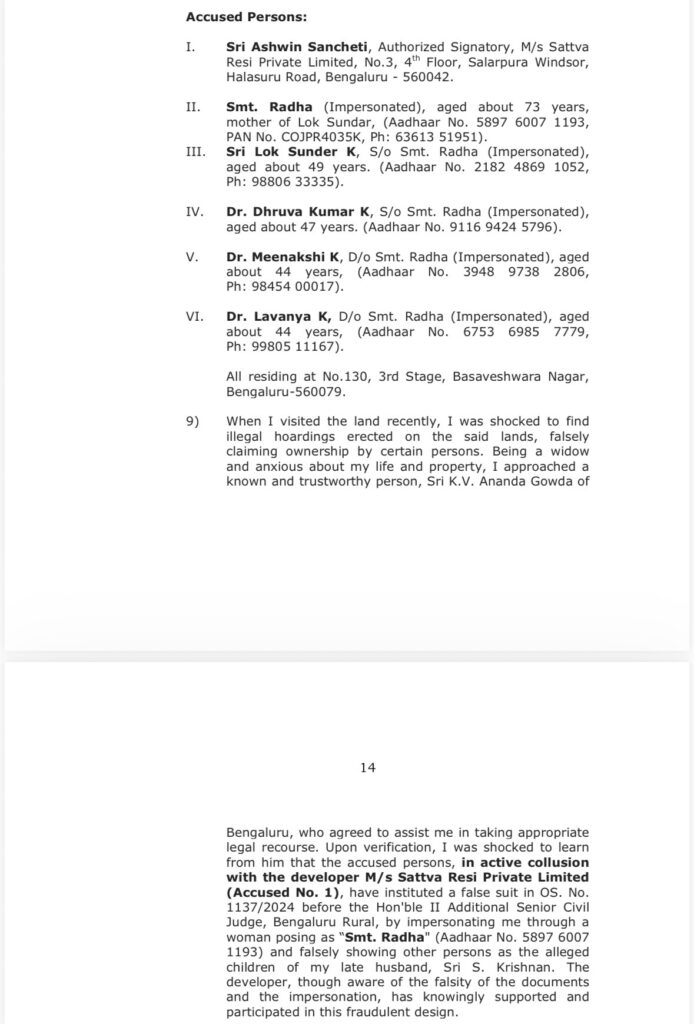
The complaint, extracted at length in the court’s order , names M/s Sattva Resi Private Limited as Accused No.1 and alleges that the company, through its authorised signatory, acted in concert with impersonators who posed as landowner Smt. R. Radha and her purported family members to execute a Joint Development Agreement (JDA), General Power of Attorney (GPA), gift deeds and sale deeds.
Allegations of Impersonation and Forged Chain of Documents
The complainant, K. Venkatappa, who claims to hold a Special Power of Attorney from 65-year-old Smt. R. Radha, alleged a “sprawling and well-orchestrated fraud” relating to around 13 acres and 29 guntas of land in Survey Nos. 20, 21 and 44/1 at Bandapura village, Bidarahalli Hobli.
According to the complaint, multiple persons allegedly impersonated Radha and her children before Sub-Registrar offices and executed:
- Agreements to sell,
- Deeds of declaration,
- Gift deeds,
- Sale deeds dated April and June 2024,
- A JDA and GPA dated August 2023.
It is alleged that the transactions involved wrongful transfers of land worth approximately ₹15 crore. The complaint also alleges that compensation of ₹11.43 lakh paid by the National Highways Authority of India for partial land acquisition was fraudulently withdrawn by an impersonator.
Three distinct “sets” of accused have been identified — alleged impersonators and their associates, the petitioner and others said to have created and registered additional documents, and witnesses to the transactions.
Petitioner’s Case: Purely Civil Dispute
Senior counsel appearing for the petitioner argued that the dispute was essentially civil in nature, pointing out that multiple civil suits — including O.S. Nos. 859/2025, 2146/2023 and 1137/2024 — are pending before civil courts challenging the same sale deeds.
It was contended that:
- The grounds raised in the criminal complaint mirror the issues in the civil suits;
- The complainant had already approached civil courts seeking declaration that the sale deeds are null and void;
- The criminal case was an attempt to give a “criminal colour” to a property dispute;
- Criminal proceedings should not continue unless and until a civil court first determines that fraud had occurred.
Reliance was placed on Supreme Court precedents to argue that when a dispute is purely civil, criminal prosecution amounts to abuse of process.
Complainant, State Oppose Quashing
Senior counsel for the complainant countered that the case involved large-scale impersonation, with multiple individuals allegedly posing as Radha and her family members.
He argued that:
- The real Radha had never appeared before the Sub-Registrar;
- Forged signatures and fabricated identities were used;
- The developer knowingly entered into transactions on the strength of forged documents;
- The case involved ingredients of impersonation, forgery, cheating and criminal conspiracy — not merely rival claims of title.
The High Court Government Pleader submitted that investigation had progressed substantially and that forensic reports on alleged forged signatures had been obtained. He contended that a cartel appeared to have targeted vacant lands and created documentation to grab them.
Court: Civil and Criminal Remedies Not Mutually Exclusive
Rejecting the petitioner’s plea, the High Court held that the pendency of civil suits cannot by itself justify quashing of criminal proceedings where allegations disclose cognisable offences.
The court relied on recent Supreme Court rulings to reiterate that:
- Civil and criminal remedies can coexist;
- The existence of a civil dispute does not bar criminal prosecution if ingredients of offences such as forgery, cheating or impersonation are made out;
- Courts must be slow to interfere with investigation at a nascent stage.
The order observes that the allegations “traverse far deeper into the realm of deceit, impersonation, forgery and calculated fraud” and are not confined to breach of contractual obligations or title disputes.
It further noted that investigation is necessary to ascertain who the alleged impersonators are and how the documents were registered.
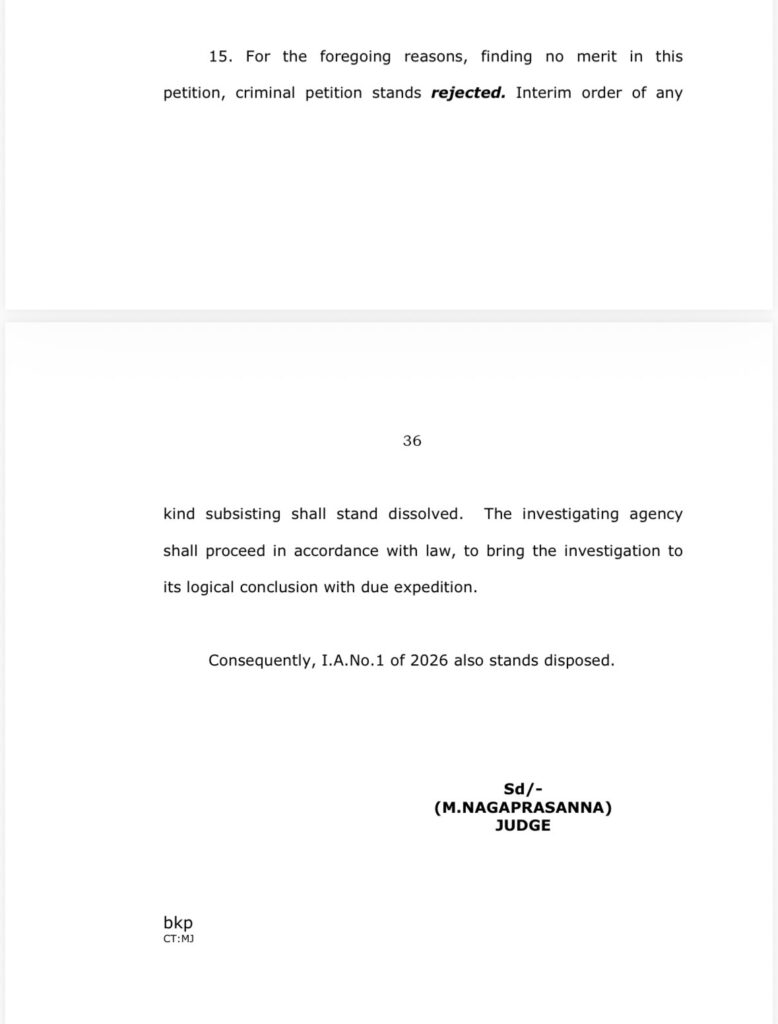
An interim stay on investigation granted earlier was dissolved. The court directed the investigating agency to proceed in accordance with law and bring the probe to its logical conclusion expeditiously.
Holding that the petition was devoid of merit, the court dismissed the criminal petition and disposed of the connected interim application.
READ MORE: