
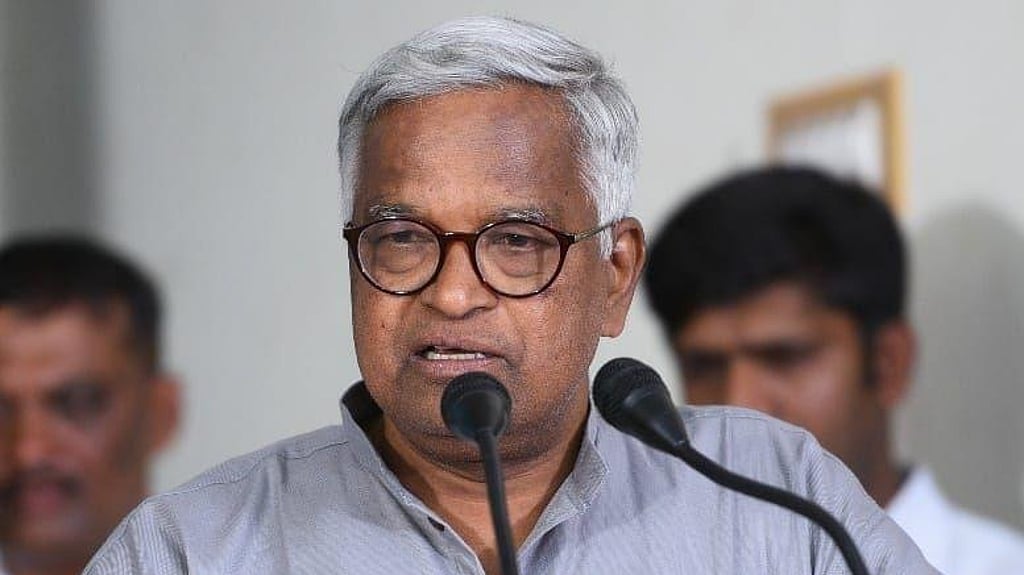
Purushottam Bilimale. Image Credit: The News Minute
Clause 5 is dangerous: Bilimale warns Kerala bill will impose Malayalam on border districts
Bengaluru
Kannada Development Authority (KDA) Chairman Purushottam Bilimale has mounted a sharp critique of the Kerala government’s proposed Malayalam Language Bill, 2025, warning that its core provisions could result in the forced imposition of Malayalam in linguistically diverse regions such as Kasaragod, where Kannada is officially recognised as a minority language.
Speaking to blrpost.com, Bilimale said Clause 5 of Chapter III, which mandates Malayalam as the language for all official purposes in Kerala, was “deeply problematic” and would be implemented rigorously, unlike Clauses 6 and 7 that ostensibly protect linguistic minorities. “Clause 5 will be enforced without compromise. Clauses 6 and 7 are cosmetic safeguards that exist only on paper,” he said. He advised Kerala government to incude clause 6 and 7 under clause 5 to make it more inclusive and effective.
The Bill seeks to repeal the Kerala Official Languages Act, 1969, and establish Malayalam as the dominant language across governance, education, administration, courts, public signage and official communication. While the Kerala government has positioned the legislation as a corrective measure to strengthen and protect Malayalam, Bilimale argued that the drafting reveals a centralising impulse that sidelines minority languages.
Clause 5, the most consequential provision, declares Malayalam as the sole language for all official purposes across government departments, local self-government bodies, public sector undertakings, autonomous institutions and cooperative bodies. Although the clause allows English for communication with the Union government, courts, foreign entities and other States, Bilimale said the provision leaves little room for linguistic plurality within Kerala’s administrative framework. “In districts like Kasaragod, officials will insist on Malayalam for all administrative interactions. This is not promotion of language; it is imposition,” he said.
The Kerala government has pointed to Clause 6, which mandates Malayalam as the compulsory first language in government and aided schools up to Class 10, while allowing students to learn Malayalam in addition to their mother tongue. Bilimale dismissed this as inadequate. “Declaring Malayalam as the compulsory first language automatically pushes minority languages to the margins. The so-called choice is illusory,” he said.
Clause 7, which provides special provisions for Tamil and Kannada linguistic minorities, allows minorities in notified areas to correspond with the government in their own language and receive replies in the same language. It also permits students to study in languages of their choice, subject to availability and national education norms, and exempts non-Malayalam students from writing certain examinations in Malayalam. Bilimale, however, said these provisions may lack enforceability. “These clauses depend on notifications, discretion and goodwill. Clause 5, on the other hand, is absolute and statewide,” he said.
The Karnataka government, led by Chief Minister Siddaramaiah, has opposed the Bill, citing concerns over the rights of Kannada-speaking communities in Kerala’s border districts. Bilimale said Kerala must amend Clause 5 by explicitly incorporating the minority protections outlined in Clauses 6 and 7. “If Kerala is serious about linguistic harmony, minority safeguards must be part of the core provision, not appended as exceptions,” he said.
As the Bill awaits assent from the Governor, resistance from Karnataka and minority language groups is expected to grow, setting the stage for a wider inter-State debate on linguistic rights and federal balance.