

Representative Image of the hospital
Dharmasthala row: K S Hegde hospital refuses RTI request on forensic research
Mangaluru
Justice K S Hegde Charitable Hospital in Deralakatte in Mangaluru has declined to provide information sought under the Right to Information (RTI) Act regarding forensic research conducted under Dr Mahabala Shetty, citing its status as a private, self-financing institution under Nitte (Deemed to be University).
This refusal comes amid heightened public interest following controversies surrounding mass burials and post-mortem practices in Dharmasthala. It should also be noted that Mahabala Shetty recently resigned from the institution. Blrpost.com has carried a detailed report (read here) on his resignation.
The RTI application, submitted on October 14, 2025, by T H M Rajakumara of Ballary district, requested detailed records of all research projects undertaken in the hospital’s forensic department from 2018 to 2025 under Shetty. Specifically, the applicant sought the titles of research projects, the year of execution, and the names of sponsoring institutions. He also requested copies of approvals issued by the Institutional Ethics Committee or Research Review Board for each project, along with the total number of samples—such as autopsy samples, bone tissue, and other materials—used in each study.
Additionally, the RTI asked for the hospital’s standard operating procedures (SOPs) or guidelines regarding the storage, handling, and disposal of post-mortem samples, as well as a list of publications by Shetty or the forensic department, including publication years and journals. The application also sought records provided by the forensic department to government, police, or municipal authorities concerning unidentified bodies and post-mortem cases, excluding any personal identifiers.
In its official response dated October 30, 2025, K S Hegde Hospital clarified that it is a private hospital under the administrative and financial control of Nitte (Deemed to be University). Citing a 2015 Karnataka High Court ruling (W.P.(C) 25114/2009, Manipal University vs. S.K. Dogra and others), the hospital stated that deemed-to-be universities are private entities and do not fall under the definition of “public authority” as envisaged by the RTI Act. The hospital also referenced a 2014 Central Information Commission ruling (Savinaya, Dakshina Kannada vs. Nitte University) which reaffirmed that Nitte University, as a self-financing private institution, is not obligated to provide information under RTI provisions. Consequently, the hospital returned the postal order submitted with the RTI request and formally rejected the application.
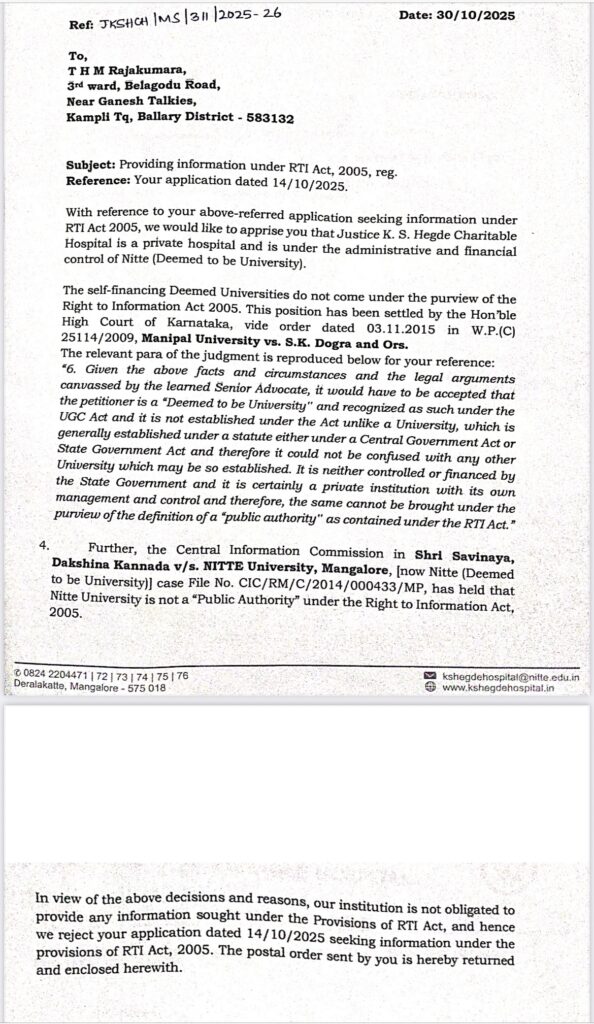
While K S Hegde Hospital is located in Mangaluru and independent of Dharmasthala’s administration, the RTI request reflects ongoing public scrutiny over post-mortem practices in the region, particularly after reports of mass burials and concerns regarding unidentified bodies in Dharmasthala. Activists and residents have been demanding transparency and accountability in forensic research, sample management, and reporting of unidentified cadavers.
The refusal has sparked debate about the limits of the RTI Act, especially regarding private institutions conducting forensic and medical research with potential public implications. Observers note that while private hospitals and deemed universities are legally outside RTI purview, the lack of accessible information may fuel public mistrust, especially in sensitive cases involving unidentified bodies and post-mortem procedures.
The hospital’s decision highlights the challenges faced by citizens seeking data on forensic research in private institutions, and the case may reignite discussions on whether such entities handling sensitive research should be made more transparent to the public.