
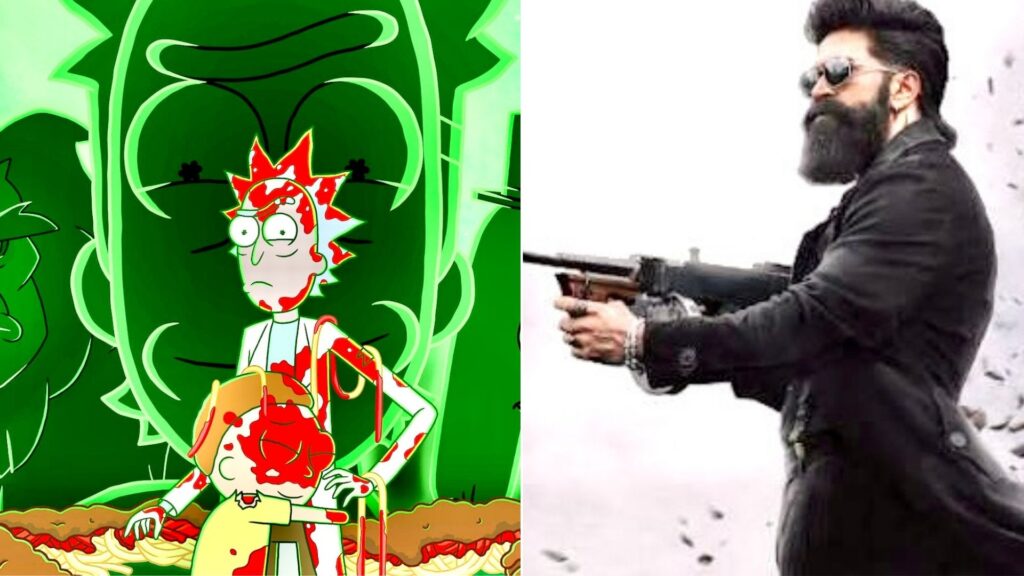
Rick and Morty is the real fairy tale for adults—Not Yash’s Toxic
The release of the Toxic teaser has triggered a familiar cycle in Indian popular culture: outrage first, interpretation later. A brief scene—suggestive rather than explicit—has been seized upon as “obscene,” while the film’s tagline, “Fairy tale for grown-ups,” is being repeated as if provocation itself were proof of depth.
But a tagline does not make a philosophy, and sensuality and violence does not automatically translate into adulthood. Based solely on what the teaser reveals, Toxic looks less like a fairy tale for adults and more like a stylised story leaning on shock value to announce its seriousness. If one truly wants to understand what a fairy tale for adults looks like in contemporary culture, the answer lies not in a slow-motion teaser shot, but in an animated series that dares to dismantle the very idea of comfort: Rick and Morty.
A fairy tale, traditionally, is not about innocence. It is about moral conflict, existential fear, transformation, and consequence—often wrapped in metaphor. When such a form is meant for adults, it must do more than titillate. It must confront the adult condition: despair, meaninglessness, love corrupted by power, intelligence stripped of purpose, and the terrifying freedom of choice. Rick and Morty does precisely this, episode after episode, using science fiction as its enchanted forest and dark humor as its narrative spell.
Calling Toxic a fairy tale for grown-ups because it contains a sexually suggestive moment is a shallow reading of adulthood itself. Adult life is not defined by access to sex or the breaking of taboos; it is defined by the collapse of certainty. The Toxic teaser, at least so far, signals attitude rather than inquiry. It hints at excess, danger, and masculinity under pressure, but these are genre elements, not philosophical ones. There is nothing inherently wrong with that—but branding it as a fairy tale elevates expectation. And expectation invites scrutiny.
Rick and Morty earns that label because it operates like a modern Grimm tale written after Nietzsche.
Rick and Morty is an animated science-fiction comedy that blends absurd humor with sharp philosophical insight. Created by Justin Roiland and Dan Harmon, the series follows Rick Sanchez, a reckless genius scientist, and his anxious grandson Morty as they travel across dimensions and alternate realities. Beneath its crude jokes and chaotic adventures, the show explores complex themes such as existentialism, free will, morality, and the meaninglessness of existence. Rick’s nihilism clashes with Morty’s growing conscience, creating emotional depth rarely seen in adult animation. The series challenges viewers to laugh while confronting uncomfortable truths about life, family, and identity.
The real fairy tale
Its universe is infinite, indifferent, and brutally logical. Rick Sanchez is not a hero; he is a wizard cursed by his own omnipotence. Like the sorcerers of old folklore, his power isolates him. He can bend reality, but cannot escape grief, addiction, or the knowledge that nothing truly matters. That is a profoundly adult idea: not that life is dark, but that meaning is not guaranteed.
Morty, on the other hand, is the fairy-tale child forced to grow up too soon. Through him, the show explores the violence of awareness. Each adventure strips away another illusion—about family, morality, or heroism. There are no clean victories, only survival with scars. In classic fairy tales, the child returns changed, often traumatized. Rick and Morty understands this and refuses to soften it for comfort.
Most importantly, the series never mistakes cynicism for maturity. Its humor is crude at times, yes, but it is never the point. The point is existential confrontation. Episodes wrestle with questions most adult storytelling avoids: If the self is replaceable across universes, what does love mean? If intelligence cannot save you from suffering, what is it for? If the universe has no moral center, how do you justify kindness at all? These are fairy-tale questions for an age that has outgrown gods but not fear.
By contrast, the Toxic teaser’s controversy says more about audience anxiety than artistic courage. Compared to international cinema, the scene in question is mild—hardly radical, hardly boundary-shattering. Treating it as obscene reveals a cultural tension, not a thematic breakthrough. And dismissing criticism by invoking global standards misses the point entirely. The issue is not whether the scene is acceptable; it is whether it earns the grand claim made by the film itself.
A fairy tale for adults does not announce its adulthood through flesh or provocation. It proves it through ideas that linger uncomfortably after the screen goes dark. It unsettles rather than shocks. It asks questions without promising answers. Rick and Morty does this relentlessly, even when it hurts its own characters and alienates its audience. That risk is what makes it honest.
Toxic may yet surprise when it releases. A teaser is not a verdict. But based on what is visible now, calling it a fairy tale for grown-ups feels premature and inflated. For now, it is simply a story—stylish, provocative, and unapologetic. There is nothing wrong with that. But fairy tales, especially adult ones, demand more than posture.
If adulthood is about facing the void without blinking, then Rick and Morty stands firmly in that tradition. It is the fairy tale that tells grown-ups what they already fear to know—and dares them to laugh anyway.