
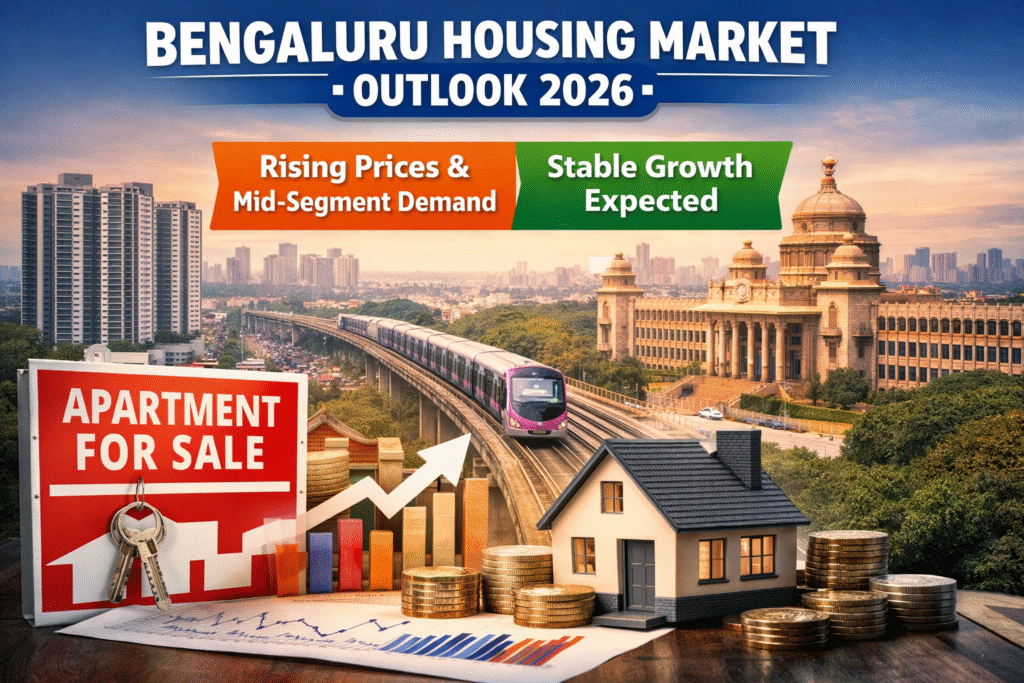
Bengaluru housing market shows resilience as mid-segment demand strengthens heading into 2026
Bengaluru:
Bengaluru’s residential real estate market continued to demonstrate steady, end-user-driven momentum in 2025, even as India’s broader housing sector entered a phase of transition marked by stabilising volumes and rising deal values.
According to Square Yards’ latest report, “2025 Recap, 2026 Outlook: Residential Real Estate”, the city remains one of the most resilient southern markets, supported by sustained demand from salaried professionals and improving mid-segment affordability .
While registered residential transactions across India’s nine prime residential markets declined by 5% year-on-year in 2025, Bengaluru maintained consistent buyer interest, particularly from genuine homebuyers rather than investors. The city recorded approximately 0.1 lakh residential transactions, translating into a registered sales value of about ₹0.1 lakh crore, reflecting Bengaluru’s relatively moderate ticket sizes compared to western markets such as Mumbai and Pune .
One of the most notable trends in Bengaluru during 2025 was the sharp rise in property prices. Average residential prices in the city increased from ₹9,050 per sq. ft in 2024 to ₹10,800 per sq. ft in 2025, marking a 19% year-on-year appreciation. Since the pre-Covid period in 2019, Bengaluru prices have nearly doubled, recording a cumulative growth of 98%, underscoring the city’s long-term structural demand .
Despite this appreciation, Bengaluru continues to remain more affordable than several other Tier-1 cities, particularly Mumbai MMR and Gurugram, helping it retain its appeal among IT professionals, startup employees and mid-income households.
Unlike western markets where premium and luxury housing dominated value growth in 2025, Bengaluru’s demand profile remained largely end-user-centric. Mid-income housing, especially homes priced between ₹80 lakh and ₹1.5 crore, is emerging as the city’s primary growth driver as the premium segment begins to show early signs of saturation nationally .
Industry experts note that infrastructure expansion along corridors such as Whitefield, Sarjapur Road, North Bengaluru and parts of the Outer Ring Road is gradually pushing residential development into peripheral micro-markets, where pricing remains relatively stable and supply quality has improved.
“This divergence reflects a maturing market, where growth is increasingly shaped by demand rather than volume-led expansion,” said Tanuj Shori, Founder & CEO, Square Yards, adding that sustained price appreciation in premium micro-markets is testing affordability thresholds, making mid-segment housing more attractive for incremental demand .
On the supply side, Bengaluru continued to be part of a broader uptrend in residential launches across major Indian cities. New residential supply across key markets increased by 18% year-on-year in 2025, indicating strong developer confidence backed by disciplined project execution and regulatory oversight under RERA .
Developers in Bengaluru are increasingly focusing on compact, efficiently designed homes with better amenities, catering to nuclear families and first-time buyers seeking value-driven purchases rather than speculative investments.
Looking ahead, the Square Yards report suggests that 2026 will mark a phase of equilibrium for Bengaluru’s housing market, with steady transaction volumes, elevated average ticket sizes and more balanced price growth across segments. As premium markets stabilise nationally, Bengaluru’s mid-segment is expected to anchor incremental demand, supported by employment growth, infrastructure development and improving affordability metrics .
Overall, Bengaluru appears well-positioned to sustain long-term residential demand, reinforcing its status as one of India’s most reliable end-user housing markets amid a broader national shift from expansion to consolidation.