
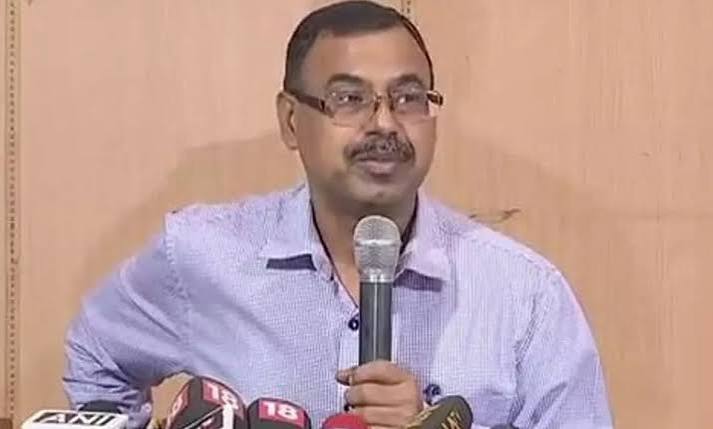
IPS B K Singh
Why government should keep incompetent B K Singh away from Sowjanya SIT
Bengaluru
The name of Additional Director General of Police (ADGP) B K Singh is reportedly among those being considered to head the new Special Investigation Team (SIT) proposed to reinvestigate the rape and murder of 17-year-old Sowjanya.
But Singh’s record in two high-profile investigations has raised serious questions over whether he is the appropriate officer to lead a case as sensitive as the Sowjanya murder, where the investigating team will have to revisit evidence, scrutinise the conduct of previous investigators and pursue every possible lead within a tight timeframe and advanced technologies.
The two cases point to a recurring concern: whether the investigating machinery under Singh acted with the urgency required in cases involving influential accused and politically sensitive allegations.
In the POCSO case registered against former Karnataka Chief Minister B S Yediyurappa, the FIR was registered on March 14, 2024 in Sasadhivanagar police station. The case was transferred to the Criminal Investigation Department (CID) the very next day. Despite the serious nature of the case, the CID did not immediately take custodial action against the accused. Singh was heading the investigation.
The CID waited nearly three months before issuing an appearance notice on June 12, 2024.
The delay proved consequential. Yediyurappa travelled to New Delhi and, following his non-appearance, a fast-track special court issued a non-bailable warrant on June 13.
What followed raises an even more serious question about enforcement.
Despite the issuance of the NBW, the investigative machinery did not immediately execute it. Within a day, on June 14, Yediyurappa approached the Karnataka High Court and obtained interim protection from arrest.
The sequence raises a fundamental question: why was there a delay between registration of the FIR, issuance of the appearance notice and enforcement of the warrant when the case involved cognizable and non-bailable offences?
For an ordinary accused facing a POCSO case, investigative agencies are routinely expected to act with urgency. The prolonged gap in this case created an opportunity for the accused to seek legal protection before the investigating agency could enforce the warrant.
The second investigation directly concerns Singh’s leadership.
On September 18, 2025, Congress leader Rahul Gandhi held a press conference in New Delhi alleging large-scale manipulation of electoral rolls in the Aland Assembly constituency. The issue generated considerable political attention and prompted the Karnataka government to constitute an SIT headed by Singh.
The SIT inherited substantial material from the earlier investigation conducted by the cyber wing.
According to a senior Congress leader, one of the first steps expected from the SIT was to issue notices under Section 35(3) of the Bharatiya Nagarik Suraksha Sanhita (BNSS) to former BJP MLA Subhash Guttedar and his son Harshananda Guttedar and proceed against them in accordance with law.
Instead, the Guttedars obtained anticipatory bail on October 31—41 days after the SIT was constituted.
The timing is difficult to ignore.
The SIT subsequently named seven accused in its interim chargesheet but arrested only one person, Bapi Adya, who has since obtained bail. Subhash Guttedar and Harshananda Guttedar were not arrested.
This is particularly significant because the SIT’s own investigation, according to the material available, alleged a systematic operation to delete voters from the electoral rolls.
Investigators alleged that 5,994 fraudulent Form 7 applications were submitted between December 12, 2022, and February 16, 2023. The applications were allegedly made using fabricated identities and without the knowledge or consent of the voters whose names were targeted.
The alleged operation involved Akram Pasha, his brother Aslam Pasha and their relative Mohammed Ashfaq. Investigators alleged that multiple NVSP accounts were created using fabricated credentials obtained from an online platform operated by Bapi Adya.
The SIT also alleged that ₹80 was paid for every fraudulent Form 7 application.
Searches at locations linked to the Guttedars allegedly revealed that important evidence had already been destroyed, including material that investigators claimed had been burnt at premises in Aland.
Against this backdrop, the failure to arrest the alleged principal accused before they obtained anticipatory bail becomes an important question about the investigation’s operational strategy.
The Congress leader who spoke to Blrpost.com alleged that the investigation appeared to be a “please-all” exercise—one that sought to satisfy Rahul Gandhi and the Congress leadership politically while simultaneously accommodating political interests involving the Guttedars and sections of the ruling party.
The SIT also cited the Election Commission’s failure to provide technical data as a major obstacle. According to police sources, the CID had written to the ECI 18 times without receiving a response.
The question raised by critics within the Congress, however, is whether the absence of ECI data prevented the SIT from taking action against the accused already identified during the investigation.
The investigation was nevertheless proceeded with and a nearly 22,000-page chargesheet was prepared, naming seven accused. Yet the decision to file an interim chargesheet while the investigation remained incomplete has itself drawn criticism from within the Congress.
The two cases present different facts and cannot simply be equated. But together, they raise a broader question about Singh’s approach to sensitive investigations: whether his teams have acted swiftly enough at critical stages, particularly when delay could provide accused persons an opportunity to secure judicial protection.
That question assumes greater importance in the Sowjanya case.
The Supreme Court has now ordered a de novo investigation into the 2012 rape and murder. The new SIT will have to work against the clock, revisit investigations that have already failed and examine evidence that has been the subject of intense public and legal scrutiny.
The investigation cannot afford delays at critical stages. Nor can there be any perception that influential individuals are being treated differently from ordinary accused persons.
The record of the Yediyurappa case raises questions over delayed enforcement. The Aland investigation raises questions over the timing of action against the alleged principal accused, despite the SIT having inherited investigative material and subsequently naming them in its chargesheet.
These are not, by themselves, findings that Singh is incapable of leading the Sowjanya probe. But they provide legitimate grounds for asking whether an officer whose previous investigations have attracted such questions should be entrusted with a case in which speed, independence and uncompromising pursuit of evidence will be central to restoring public confidence.
For the Sowjanya family and for an investigation that has already gone through years of legal and investigative uncertainty, the identity and record of the SIT chief will therefore be as important as the composition of the team itself.