
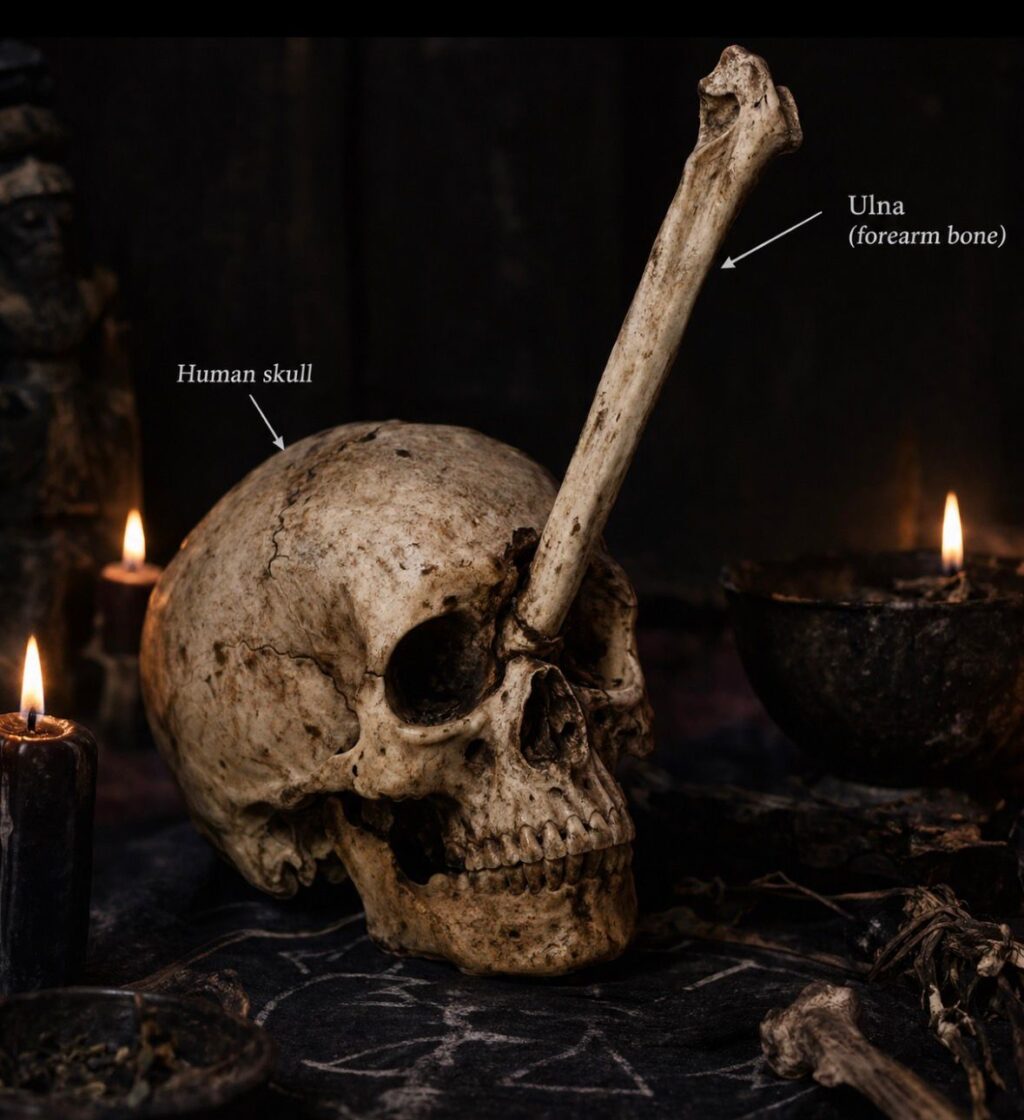
AI image of bone placement described in the report
Ulna inserted in the skull: SIT report records bizarre skull-bone placement at Banglegudde
Bengaluru
A forearm bone was found inserted into a human skull recovered during the Special Investigation Team’s recovery of human skeletal remains at Banglegudde in the Dharmasthala mass-burial case, with the forensic record specifically describing the placement as “Ulna inserted in the skull.”
The detail appears in a page of the SIT’s report concerning Article No. 90, one of the skeletal remains recovered during the investigation.

According to the report, the remains were recovered at Spot No. 1 at Banglegudde on September 17, 2025. A driving licence bearing the name Adi Shesha Narayana, son of Bojanna, of Dasarahalli, Gubbi taluk, Tumakuru, was also recovered from the site.
The SIT subsequently traced a woman identified in the report as Padma, who identified the driving licence as belonging to her brother, Adi Shesha Narayana. The report said that her statement was subsequently taken by the investigating team.
The forensic examination later focused on Article No. 90, described in the report as “Ulna inserted in the skull.” DNA samples were obtained from the skeletal material and compared with samples provided by the biological relative Padma for identification. The DNA was matched during the forensic examination.
What does “ulna inserted in the skull” mean?
The ulna is one of the two long bones of the human forearm. It runs from the elbow to the wrist, alongside the radius.
Therefore, the phrase “Ulna inserted in the skull” literally means that an ulna bone was physically placed through or inside the skull, rather than being in its normal anatomical position as part of the forearm.
That is a highly unusual finding in a burial or skeletal context. Normally, the bones of a body would be expected to remain broadly associated according to their anatomical positions, although decomposition, disturbance of a burial, excavation and movement of remains can displace bones.
Does it indicate black magic?
The unusual positioning of a bone inside a skull can raise questions about whether the remains were deliberately arranged, particularly if investigators establish that the positioning could not have resulted from natural decomposition or later disturbance.
Human bones, skulls and other remains have historically appeared in various occult and ritual practices, including practices popularly described as black magic. In some traditions, skulls and bones have been used as ritual objects or believed to possess supernatural significance.
However, the phrase “Ulna inserted in the skull” by itself does not establish that black magic was involved. There would have to be additional forensic or investigative evidence showing that the bone was deliberately inserted, when it was inserted, and why. The SIT report page, as seen here, records the unusual physical configuration; it does not, on this page, attribute it to black magic.
The DNA examination is significant because the SIT was attempting to establish the identity of the remains associated with Article No. 90 through comparison with the biological relatives. The report records the exhibit and the DNA examination separately from any interpretation of the manner in which the remains came to be positioned.
Blrpost.com has accessed a portion of the SIT report page containing the description “Ulna inserted in the skull.”