
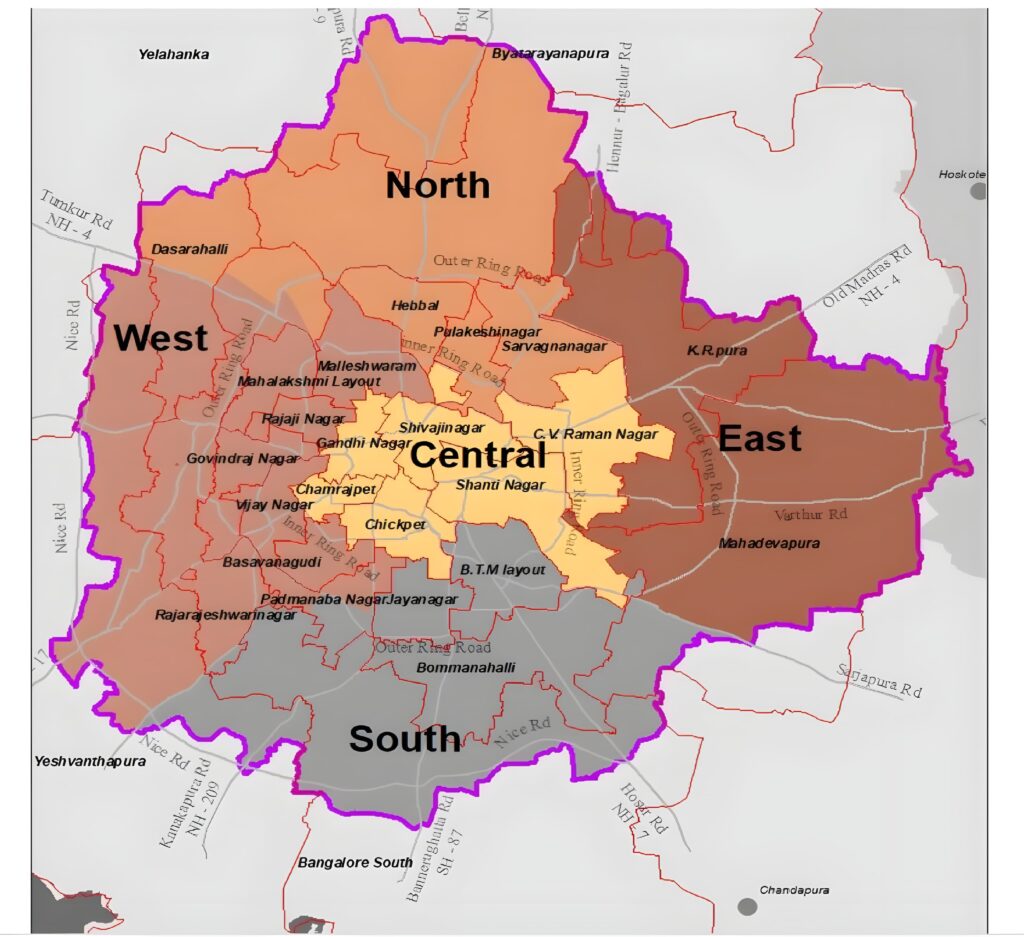
Map of five corporations
SC sets June 30 deadline for Bengaluru corporation elections
Bengaluru/New Delhi
The Supreme Court on Monday fixed June 30, 2026, as the outer limit for completing the long-pending election process to the Bengaluru corporations, making it clear that no further extensions will be granted, Live Law reported.
A bench comprising Chief Justice of India Surya Kant and Justice Joymalya Bagchi directed the Karnataka government to publish the final ward-wise reservation notification by February 20, 2026. Appearing for the State, Senior Advocate Dr Abhishek Manu Singhvi assured the court that the reservation exercise would be completed within a month.
The State Election Commission (SEC) informed the bench that the final voters’ list is scheduled to be published on March 16, 2026. Senior Advocate K.N. Phanindra, appearing for the SEC, submitted that elections could realistically be held only towards the end of May, once board examinations conclude and schools and colleges become available for use as polling stations. He added that teachers and educational institutions are essential for election duties and assured the court that polling would be scheduled immediately after the exams end on May 26.
Taking note of these submissions, the bench directed that the election process begin without delay after the completion of examinations, categorically ordering that the corporation elections must, in all circumstances, be concluded before June 30, 2026.
The matter arises from a prolonged legal battle over corporation elections. The Supreme Court is hearing the Karnataka government’s challenge to a December 4, 2020, Karnataka High Court judgment that directed the SEC to hold corporation elections expeditiously. That order was stayed by the apex court on December 18, 2020. In 2022, the Supreme Court had further directed the State to complete ward delimitation within eight weeks.
The dispute centres on whether elections should be conducted for 198 wards, as per an earlier delimitation notification, or 243 wards following the Karnataka Municipal Corporation Third Amendment Act, 2020, which increased the number of wards. The High Court had upheld the validity of the amendment but ruled that it could not apply to elections that were constitutionally due before the amendment came into force.