
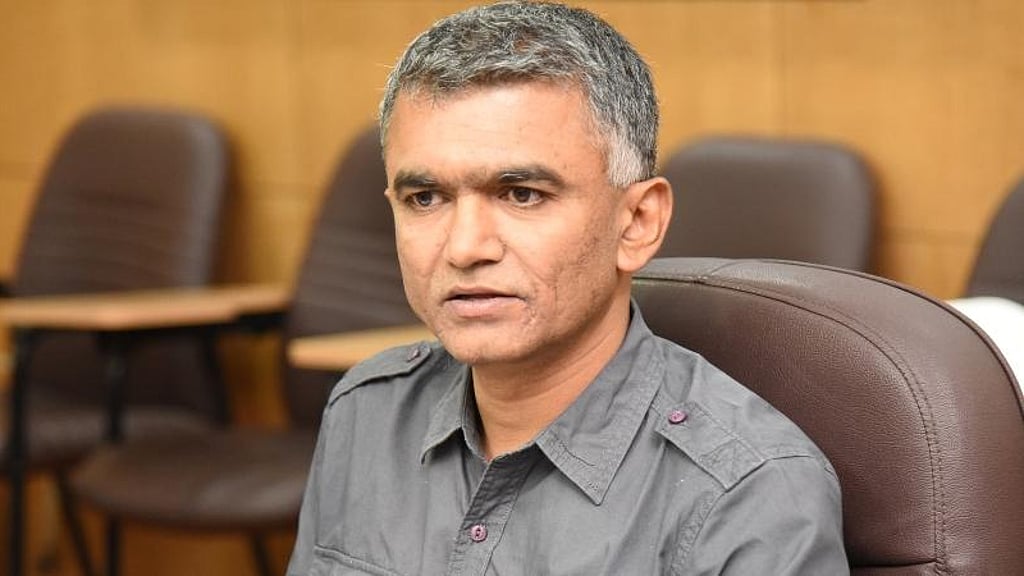
Krishna Byre Gowda: Image Credit: TNIE
Krishna Byre Gowda, before you question civic workers, question the system
By all means, demand that civic workers report for duty. But before questioning their attendance, ask yourself whether the government has done its duty.
There is nothing unreasonable about expecting civic workers to turn up for work. Sanitation is an essential public service. When sanitation workers stay away, garbage piles up, streets become filthy and public health is put at risk. Government employees must be accountable, and no one can seriously dispute that.
But accountability cannot be a one-way street.
That is the uncomfortable question Greater Bengaluru Development Minister Krishna Byre Gowda’s recent remarks raise.
While speaking to civic workers, including contractual employees demanding permanent employment, the Minister appeared to treat their demand for job security with irritation. He also expressed his displeasure with workers who have already been made permanent, broadly suggesting that such employees do not work and that officials cannot even speak to them.
That is a sweeping judgement. More importantly, it betrays a disturbing lack of sensitivity towards the very people whose labour keeps the city functioning.
The workers are not privileged like the Minister. They were not people who had studied abroad, inherited wealth or grown up surrounded by political influence. They were workers seeking security from a system that has kept them on contracts for years.
And there is a larger social reality that cannot be wished away.
For generations, sanitation work has been disproportionately carried out by particular social communities. The people who clean our streets, handle our garbage, enter our drains and deal with the filth produced by the rest of society are among its least privileged.
It is easy, from an air-conditioned office, to reduce their problems to an attendance register.
It is much harder to ask what their lives actually look like.
Does every sanitation worker have adequate protective equipment? What happens when a worker falls sick because of the conditions in which he works? What medical protection does the government provide? What happens to the family when a worker dies while performing hazardous work? How many workers spend decades doing this job without ever receiving the security of permanent employment?
And why do sanitation workers continue to face grave health risks and shortened lives?
These questions deserve at least as much attention as biometric attendance.
Indeed, there is something revealing about the priorities of a system that can develop technology to detect when a worker is absent but appears far less interested in tracking whether the worker has received the wages, benefits and protections legally due to him.
How much does the government pay the contractor for each worker?
How much reaches the worker?
How much does the contractor make?
Are statutory benefits actually being provided?
Who checks whether protective equipment is purchased, distributed and used?
If the government wants efficiency, it should audit the entire chain.
Otherwise, efficiency becomes little more than a convenient word used by those in power to discipline those with the least power.
Mr Byre Gowda is not an ordinary politician. He has built a reputation for competence, seriousness and administrative ability. He has also shown a willingness to take unpopular decisions in an attempt to fix Bengaluru’s notoriously dysfunctional systems.
There is nothing wrong with demanding accountability. In fact, Bengaluru desperately needs it.
But there is a difference between reforming a broken system and humiliating the people at its bottom.
A government is not a corporation. A Minister is not a CEO and a citizen is not an employee who exists merely to meet a performance target.
Public administration requires efficiency. But it also requires empathy.
And there is one question Mr Byre Gowda, who has had the privilege of studying abroad, should perhaps ask himself before lecturing sanitation workers about discipline:
Why is it that, generation after generation, the same social communities are pushed into cleaning up society’s waste?
Why don’t the so-called upper sections of society queue up to clean drains, collect garbage and handle the waste that all of us generate?
There is a profound social answer to that question.
Find it, and the Minister will understand why a worker asking for permanent employment cannot simply be dismissed as someone unwilling to work.
He will understand why job security matters.
Why wages matter.
Why protective equipment matters.
Why healthcare matters.
Why housing matters.
Why the education of workers’ children matters.
And why the contract system deserves far greater scrutiny than it receives.
The GBA is perfectly entitled to demand that a worker who is paid to work should turn up for duty. There is no justification for absenteeism.
But before punishing absence, the administration should also ask what lies behind it. A missing attendance entry is a number. A worker’s life is not.
Mr Byre Gowda has been trying to shake up a system that has remained stagnant for years. That task will inevitably involve confrontation with officials, contractors and vested interests.
But he should know where to direct the force.
Do not use a Brahmastra to kill a sparrow.
Power is most easily demonstrated against those who cannot fight back. Leadership is demonstrated by having the wisdom to know when not to use it.
Especially when speaking to the weakest sections of society, language matters.
No university degree teaches this. It comes from stepping outside one’s comfort zone and trying, even briefly, to see the world from the other person’s position.
Could the privileged among us do what a sanitation worker does for even one day?
That question should humble us.
Bengaluru’s sanitation workers do not need lectures on dignity. They need the dignity that comes from fair wages, secure employment, safe working conditions, healthcare and social security.
They need protection from contractor exploitation.
And, above all, they need to be treated as human beings.
If the government genuinely wants a cleaner and more efficient Bengaluru, it must clean up the system that employs those who clean the city.
Because you cannot build a clean city by humiliating the hands that clean it.
A city may be spotless, technologically advanced and efficiently administered.
But if the people who make that possible are treated without dignity, it is not a civilised city.
It is merely a high-tech graveyard.