
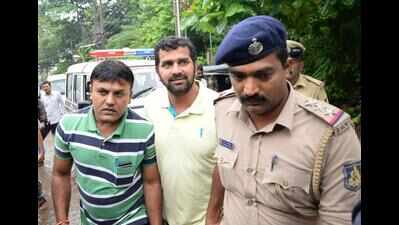
Accused Naresh Shenoy is seen with the police after the arrest
Anuradha Baliga’s unexplained silence: Why her trial testimony leave out the conspiracy she sought to investigate?
Mangaluru
An unexplained gap has emerged in the trial of murdered RTI activist Vinayaka Baliga: the allegations of a wider conspiracy that his sister Anuradha Baliga herself placed before the court in her application seeking reinvestigation do not appear to have been brought out with the same detail in her evidence before the trial court.
The discrepancy assumes significance because the reinvestigation application in 2017 was not a passing allegation. It specifically sought further investigation into circumstances and persons whom Anuradha had identified as potentially connected with the alleged conspiracy behind her brother’s murder.
According to the material available in the case, the application referred to the alleged roles of Kashi Mutt seer Samyendra Tirtha Swamiji, Jagannath Kamath, Vedavyas Kamat, Vishwanath Bhat, Vijayananda Shenoy of Bantwal, Narayana Shenoy, secretary of Kashi Mutt, and others. The application also referred to circumstances surrounding the alleged conspiracy and sought investigation into the larger chain of events.
Yet, according to the evidence now available, Anuradha’s testimony before the trial court did not reproduce that wider conspiracy in its entirety. Apart from referring to Samyendra Swamiji, the detailed allegations contained in her earlier application were not brought out in the same manner.
That raises the obvious question: why did Anuradha not place before the trial court the very allegations that she had earlier told the court required reinvestigation?
The issue is important because the alleged motive for Baliga’s murder was closely linked, according to his family’s case, to his efforts to obtain a re-audit of the accounts of the Venkataramana Temple in Car Street and the accounts relating to purification works at Kashi Mutt. The family had alleged financial irregularities running into several crores of rupees and contended that Baliga’s persistence over the accounts had created powerful opposition to him.
The records cited by the family indicate that the dispute over re-audit had already reached the courts before Baliga was murdered on March 21, 2016.
His family’s allegations went beyond the accused who ultimately faced trial. The larger contention was that the physical attack on Baliga was only the final act of a broader conspiracy and that the persons who allegedly planned, financed, facilitated or otherwise assisted the murder had not all been brought before the court.
It was against this backdrop that Anuradha approached the court seeking reinvestigation under Section 173(8) of the Code of Criminal Procedure. The application was before III Additional District Judge and JMFC at Mangaluru.
Her application, therefore, assumed considerable importance: it put specific allegations and names before the investigating machinery and sought examination of the larger conspiracy.
The application was dismissed by the trial court. Anuradha challenged the order before the Karnataka High Court in Criminal Petition No.8135/2017. The High Court held that she was the de facto complainant and that an application for further investigation had to be moved by the prosecution before the Sessions Court. The matter was subsequently taken to the Supreme Court, where the challenge was dismissed.
The question now is what happened to the allegations contained in that application.
If Anuradha subsequently found that the allegations were incorrect, unsupported or had been disproved during investigation, that development itself would be relevant to the trial. If, however, the allegations continued to be her contention, their absence from her testimony becomes an issue requiring explanation.
This is particularly significant in a murder case where the prosecution has to establish not merely the occurrence of the crime but, wherever conspiracy is alleged, the circumstances connecting the accused with the planning and execution of the offence.
The omission also leaves unanswered questions about the investigation. Were the allegations in the reinvestigation application examined? Were the persons named in it questioned? Were the alleged financial transactions and communications verified? Were mobile-phone records examined in the context of the allegations? If the investigation found no material against the persons named, where is that conclusion reflected in the final investigation?
These questions matter because the investigation, according to the material cited by the family, ultimately centred on Naresh Shenoy and the persons who allegedly participated in the physical attack. The larger conspiracy alleged by Anuradha did not receive a comparable place in the trial.
There is another significant element. The family had earlier sought investigation into the circumstances surrounding an alleged meeting at Kashi Mutt and had attempted to subject Naresh Shenoy to narco-analysis and a lie-detector test. The application was opposed, and the Supreme Court’s judgment in Selvi meant that such tests could not be imposed without consent.
The family also pursued the appointment of senior special public prosecutors, including N. Ravindranath Kamath and later another senior criminal lawyer, reflecting its concern that the prosecution should pursue what it believed was the complete conspiracy.
Against this background, Anuradha’s subsequent evidence creates an unusual evidentiary gap.
Why did the person who once demanded investigation into the wider conspiracy not place that entire conspiracy before the trial court while giving evidence?
The answer cannot simply be assumed. It could have resulted from the manner in which her evidence was recorded, the scope of questions put to her, a subsequent change in her understanding of the evidence, developments during investigation, or some other legal or factual circumstance.
But unless that explanation is brought on record, the discrepancy remains.
The issue is not whether every allegation made in the reinvestigation application is true. At this stage, that cannot be presumed. Nor does the mere naming of a person in an application establish involvement in a murder.
The real issue is whether allegations that the family itself considered serious enough to seek reinvestigation were subsequently properly investigated and, if rejected, whether the reasons for rejecting them were placed before the court.
The murder of Vinayaka Baliga cannot be reduced to the question of who allegedly carried out the attack. If the prosecution’s case involves a conspiracy, the circumstances preceding the murder, the alleged motive, the persons who may have facilitated the crime and the financial or other links connecting them become relevant.
Ten years after the murder, the central question therefore remains larger than the conviction of the accused: was the entire conspiracy investigated, or did the investigation stop at the person allegedly closest to the actual assault?
And at the heart of that question is an uncomfortable contradiction in the record: the wider conspiracy was once placed before the court by Anuradha Baliga herself. Why was it not placed before the trial court in the same form when she entered the witness box?
Unless that gap is explained, the unanswered questions surrounding the alleged conspiracy will continue to shadow the trial.